
Kimi K3 vs Claude Fable 5: Complete Analysis
Kimi K3 vs Claude Fable 5 across 35 benchmarks, pricing, architecture, context, tools, vision, and production tradeoffs.

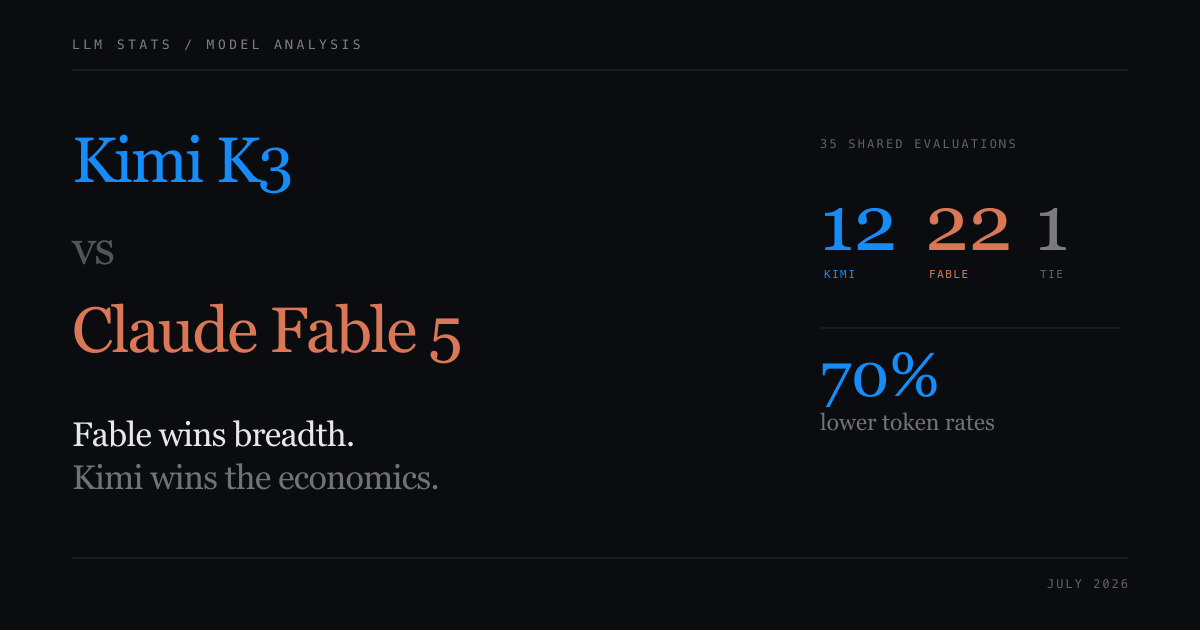
The Verdict
Claude Fable 5 is the stronger model across the full evaluation suite. Kimi K3 is the more disruptive product: close enough on broad capability, better on a few consequential coding tasks, one third the price, and built around an eventual open release.
Moonshot AI released Kimi K3 on July 16, 2026, positioning a 2.8-trillion-parameter sparse model against the strongest proprietary systems. Its own 35-row comparison with Claude Fable 5 is unusually useful because both models are shown at maximum reasoning effort and the table spans coding, agents, knowledge, and vision.
The whole comparison
35 shared evaluations
Fable wins breadth.
Kimi wins the economics.
Claude Fable 5 takes 22 of 35 shared evaluations. Kimi K3 takes 12, ties one, and charges 70% less per token.
12
Kimi K3
22
Fable 5
1
Tie
Win count uses the Kimi K3 launch table. Fable 5 is the production configuration with fallback enabled.
The top-line count favors Fable: 22 wins to Kimi's 12, with one tie. But a single win count hides the deployment decision. Kimi wins Terminal-Bench 2.1, SWE-Marathon, BrowseComp, and Program Bench, then charges $3 / $15per million input / output tokens. Fable's wider capability lead costs $10 / $50. The correct choice depends on whether your workload values broad ceiling or completed work per dollar.
Kimi K3 vs Fable 5 at a Glance
| Specification | Kimi K3 | Claude Fable 5 |
|---|---|---|
| Developer | Moonshot AI | Anthropic |
| Release date | July 16, 2026 | June 9, 2026 |
| API model ID | kimi-k3 | claude-fable-5 |
| Parameters | 2.8T total, 16 of 896 experts active | Not disclosed |
| Context window | 1,048,576 tokens | 1M tokens |
| Max output | 131K default, up to 1,048,576 | 128K |
| Input modalities | Text, image, video | Text, image |
| Reasoning | Always on, max only at launch | Adaptive, always on |
| Input / output price | $3 / $15 per 1M | $10 / $50 per 1M |
| Cached input | $0.30 per 1M, automatic | $1 per 1M after cache write |
| Weights | Announced open, release due by July 27 | Proprietary |
| Availability | Moonshot API at launch | Anthropic and major clouds |
Both models give agents a full million-token working set. The major spec differences sit elsewhere. Kimi accepts video, publishes its architecture, and has much lower token rates. Fable publishes no parameter count but arrives with a mature multi-cloud surface, a 128K output cap, and the stronger benchmark profile.
35 Benchmarks, One Clear Pattern
The full table comes from Moonshot's Kimi K3 technical launch post. Kimi's results use max reasoning effort. Fable is labeled max, with fallback, meaning its production safeguards can hand a trajectory to Claude Opus 4.8. This is a comparison of deployable systems, not a clean-room comparison of two sets of raw weights.
Capability map
Kimi takes the terminal.
Fable owns the wider field.
Coding
3 Kimi/5 Fable
Agentic
5 Kimi/7 Fable
Reasoning
1 Kimi/2 Fable
Vision
3 Kimi/8 Fable / 1 tie
Program Bench
K +1.0
Terminal-Bench 2.1
K +3.7
FrontierSWE
F +5.4
SWE-Marathon
K +7.0
BrowseComp
K +3.2
Toolathlon-Verified
F +4.7
HLE-Full
F +9.8
WorldVQA ForceAnswer
F +5.7
OmniDocBench
K +1.3
Fable's lead is broad rather than concentrated in one category. It wins five of eight coding evaluations, seven of twelve agentic evaluations, two of three reasoning evaluations, and eight of twelve vision evaluations. Kimi's wins cluster around executable work: terminal use, long engineering runs, browsing, automation, and a handful of document and perception tasks.
Coding
| Benchmark | Kimi K3 | Fable 5 | Leader |
|---|---|---|---|
| DeepSWE | 67.5 | 70.0 | Fable +2.5 |
| Program Bench | 77.8 | 76.8 | Kimi +1.0 |
| Terminal-Bench 2.1 | 88.3 | 84.6 | Kimi +3.7 |
| FrontierSWE | 81.2 | 86.6 | Fable +5.4 |
| SWE-Marathon | 42.0 | 35.0 | Kimi +7.0 |
| PostTrainBench | 36.6 | 41.4 | Fable +4.8 |
| MLS-Bench Lite | 48.3 | 49.9 | Fable +1.6 |
| Kimi Code Bench 2.0† | 72.9 | 76.9 | Fable +4.0 |
Agentic
| Benchmark | Kimi K3 | Fable 5 | Leader |
|---|---|---|---|
| GDPval-AA v2 | 1668 | 1760 | Fable +92 |
| BrowseComp | 91.2 | 88.0 | Kimi +3.2 |
| DeepSearchQA† | 95.0 | 94.2 | Kimi +0.8 |
| Toolathlon-Verified | 73.2 | 77.9 | Fable +4.7 |
| MCP Atlas | 84.2 | 84.7 | Fable +0.5 |
| AutomationBench | 30.8 | 29.1 | Kimi +1.7 |
| Job Bench | 52.9 | 57.4 | Fable +4.5 |
| AA-Briefcase | 1548 | 1583 | Fable +35 |
| APEX-Agents | 37.6 | 43.3 | Fable +5.7 |
| OfficeQA Pro† | 63.3 | 69.9 | Fable +6.6 |
| SpreadsheetBench 2† | 34.8 | 34.7 | Kimi +0.1 |
| DECK-Bench† | 73.5 | 73.0 | Kimi +0.5 |
Reasoning and knowledge
| Benchmark | Kimi K3 | Fable 5 | Leader |
|---|---|---|---|
| GPQA-Diamond | 93.5 | 92.6 | Kimi +0.9 |
| HLE-Full | 43.5 | 53.3 | Fable +9.8 |
| HLE-Full with tools | 56.0 | 63.0 | Fable +7.0 |
Vision
| Benchmark | Kimi K3 | Fable 5 | Leader |
|---|---|---|---|
| MMMU-Pro | 81.6 | 81.2 | Kimi +0.4 |
| MMMU-Pro with Python | 83.4 | 86.5 | Fable +3.1 |
| CharXiv (RQ) | 84.8 | 88.9 | Fable +4.1 |
| CharXiv (RQ) with Python | 91.3 | 93.5 | Fable +2.2 |
| MathVision | 94.3 | 94.8 | Fable +0.5 |
| MathVision with Python | 97.8 | 98.6 | Fable +0.8 |
| BabyVision with Python | 85.7 | 90.5 | Fable +4.8 |
| ZeroBench main (pass@5) | 23.0 | 23.0 | Tie |
| ZeroBench main with Python (pass@5) | 41.0 | 46.0 | Fable +5.0 |
| WorldVQA ForceAnswer | 51.0 | 56.7 | Fable +5.7 |
| OmniDocBench | 91.1 | 89.8 | Kimi +1.3 |
| PerceptionBench | 58.5 | 57.2 | Kimi +1.3 |
A methodological warning matters here. Several coding rows use different harnesses. Kimi runs DeepSWE and Terminal-Bench through KimiCode, while the Fable figures come from other published harnesses. SWE-Marathon is cleaner because both use Claude Code. The dagger marks internal evaluations or scores carrying an asterisk in Moonshot's source table. Treat small gaps as ties unless you reproduce them on your own stack.
Coding and Long-Horizon Agents
Coding is not a simple Fable sweep. Kimi takes three of eight rows, and two of those wins are the ones most relevant to persistent agents: Terminal-Bench 2.1 at 88.3 vs 84.6 and SWE-Marathon at 42.0 vs 35.0. It also edges Program Bench, 77.8 to 76.8. These results fit Moonshot's product focus: K3 was trained to sustain long engineering sessions, navigate large repositories, and coordinate terminal tools.
Fable wins the wider coding set. It leads DeepSWE by 2.5 points, FrontierSWE by 5.4, PostTrainBench by 4.8, MLS-Bench Lite by 1.6, and Moonshot's own Kimi Code Bench by 4.0. That last result is useful precisely because it resists a convenient story. Even on an internal Kimi coding evaluation, Fable remains ahead.
The operational read is narrower. Choose Kimi when the workload is terminal heavy, long running, and cost sensitive. Choose Fable when the task mix is unpredictable and you want the higher average ceiling. Do not infer that Kimi is universally better at coding from Terminal-Bench alone, and do not infer that Fable's 5-to-3 category lead makes Kimi a weak coding model. Both conclusions discard the task shape.
Reasoning, Knowledge, and Vision
This is where Fable earns its premium. It leads HLE-Full by 9.8 points without tools and 7.0 with tools. Kimi narrowly wins GPQA-Diamond, 93.5 to 92.6, but Fable is stronger on the broader expert-level test. The same pattern appears in agentic knowledge work: Fable leads GDPval-AA v2 by 92 Elo, AA-Briefcase by 35 Elo, OfficeQA Pro by 6.6 points, and Job Bench by 4.5.
Vision is even clearer. Fable wins eight of twelve rows, Kimi wins three, and ZeroBench without Python is tied. Fable's largest gaps appear on WorldVQA (+5.7), BabyVision with Python (+4.8), and ZeroBench with Python (+5.0). Kimi answers back on OmniDocBench (+1.3), PerceptionBench (+1.3), and MMMU-Pro without tools (+0.4).
Kimi still has one product-level multimodal advantage that the table does not score: its first-party API accepts video files, while Fable's documented input modalities are text and images. For video editing agents, visual coding loops, and long recordings, native video can matter more than a four-point benchmark gap.
Architecture and Open Weights
Moonshot publishes enough of K3's design to explain its serving thesis. The model has 2.8 trillion total parameters but activates only 16 of 896 expertsper token through Stable LatentMoE. Kimi Delta Attention introduces a hybrid linear-attention path, while Attention Residuals let deeper blocks retrieve earlier representations more selectively. Moonshot claims these changes produce roughly 2.5 times K2's scaling efficiency.
What is known
One model publishes the machine.
The other publishes the behavior.
Kimi K3
Published architecture
Claude Fable 5
Proprietary system
Parameters,
expert count,
attention design:
not disclosed.
Anthropic publishes the system card, safety behavior, context limits, and evaluations. It does not publish weights or architecture details.
Fable offers no symmetric architecture disclosure. Anthropic documents the system's observed behavior, safety layer, context limits, and training cutoff, but not parameter count or attention design. That makes architectural comparison impossible beyond surface behavior.
The word open also needs a timestamp. Moonshot calls K3 the first open-source 3T-class model, but its API documentation says full weights will arrive by July 27, after launch, with the technical report. At publication time the model is API-accessible, not yet self-hostable, and the final weight license is not published. Even after release, serving a sparse 2.8T model efficiently will be a serious infrastructure project rather than a laptop deployment.
Context, Tools, and API Behavior
Both APIs support million-token prompts, streaming, tool calls, structured output, and prompt caching. Their control surfaces differ enough to affect agent implementations.
- Kimi K3 uses an OpenAI-compatible Chat Completions API. The model ID is
kimi-k3. Reasoning is always enabled, andreasoning_effortaccepts onlymaxat launch. - Fable 5 uses Anthropic's Messages API. The model ID is
claude-fable-5. Adaptive thinking is always on, with Anthropic's task-budget and compaction features available for long agents. - Kimi adds agent-specific controls. Required tool choice, dynamic tool loading, partial-mode continuation, strict JSON Schema, and separate streaming reasoning deltas are documented first-party features.
- History handling is not interchangeable. Kimi warns that dropping prior reasoning content or switching into K3 mid-session can make output unstable. Preserve the complete assistant message across tool turns.
- Caching differs operationally. Kimi attempts prefix caching automatically. Fable uses explicit cache writes with 5-minute or 1-hour lifetimes, then bills hits at one tenth of base input.
Kimi's output limit is unusually large on paper: 131,072 completion tokens by default and up to 1,048,576. Fable caps synchronous output at 128K. In practice, generation length should be treated as a cost and reliability budget, not a goal. Million-token outputs are possible in the Kimi API contract, but most production systems should checkpoint far earlier.
Pricing and Cost per Workload
The rate-card gap is exact across base input, cached input, and output. Kimi costs 30% of Fable at every tier. Said another way, Fable costs 3.33 times as much before differences in token use or task success.
Standard API pricing
70%
less at every token tier.
A workload with 10M uncached input tokens and 2M output tokens costs $60 on Kimi K3 and $200 on Fable 5 before batch discounts.
Input
$3
$10
Cache hit
$0.30
$1
Output
$15
$50
Token price is not cost per completed task. Fable may finish some hard jobs in fewer attempts, and its 22 benchmark wins are evidence that the premium can buy higher success probability. Kimi's long reasoning traces can also consume more output than a rate-card comparison suggests. Measure total tokens, retries, tool turns, and completion rate on your own jobs.
Still, the gap is large enough to survive modest efficiency differences. If both models solve a workload at roughly the same rate, Kimi's economics dominate. If Fable materially reduces retries on expensive long-horizon tasks, paying the premium can be rational. This is why routing by task difficulty beats choosing one model for every request.
Production Caveats
Fable's published comparison score includes fallback behavior. Anthropic built Fable from the same underlying model as restricted Mythos 5, then added classifiers for cybersecurity, biology and chemistry, and model-distillation requests. In Claude apps a flagged trajectory can fall back to Opus 4.8. On the Messages API, developers must opt into or implement fallback or accept a refusal.
This matters directly to the benchmark table. Moonshot labels Fable with fallback, and notes that PostTrainBench refusals fall back to Opus 4.8 under the Claude Code harness. The Fable column therefore measures the production system a normal user can run, but not always the full Fable model. Security and life-science teams should test their real prompts before trusting aggregate scores. Our Claude Fable 5 review covers the fallback mechanism and effective benchmark impact in detail.
Kimi's caveats are different. Moonshot warns that K3 is sensitive to missing thinking history and may act too proactively on ambiguous instructions. The API fixes sampling parameters, offers only max reasoning at launch, and says its web search tool is being updated and should not be used in production. Partner inference was not available on launch day, so Moonshot was the only confirmed serverless route.
Moonshot's own launch post also says K3 still has a noticeable user-experience gap versus Fable 5. That admission matches the benchmark distribution: Kimi is highly competitive and sometimes better on executable work, but Fable remains the more consistently capable general system.
Which Model Should You Use?
There is no single winner. There is a better default for each workload.
Routing guide
Pick per workload
01
High-volume coding agents
Kimi K3
Terminal and marathon wins, 70% lower token rates, 1M context.
02
Maximum broad capability
Fable 5
Wins 22 of 35 shared evaluations, strongest across vision and knowledge.
03
Video-grounded workflows
Kimi K3
Native image and video input through the first-party API.
04
Established cloud deployment
Fable 5
Anthropic, Bedrock, Google Cloud, and Microsoft Foundry support.
05
Future self-hosting
Kimi K3
Open release planned, but 2.8T scale makes deployment a serious systems project.
Use Kimi K3 when token spend controls whether an agent can run at all, when work is terminal-heavy or extends across long engineering sessions, when video input matters, or when you want a path toward open weights. It is the more interesting price-performance model, and the 70% discount is too large to ignore on high-volume traffic.
Use Claude Fable 5 when the task is hard enough that broad capability matters more than rate-card cost, especially expert knowledge, complex vision, and mixed workloads that are difficult to route in advance. Its 22 wins across 35 shared evaluations make it the safer maximum-capability choice.
Use bothwhen you can classify difficulty. Start on Kimi for bounded, high-volume work, then escalate failures or high-value jobs to Fable. This captures Kimi's economics without giving up Fable's ceiling. Track cost per successful task, not cost per token.
Explore the complete profiles on the Kimi K3 model card and Claude Fable 5 model card, inspect them together on the LLM Stats comparison page, or run both in the Huggle Playground. For primary documentation, see Moonshot's Kimi K3 launch report and API guide, plus Anthropic's Fable 5 announcement and model documentation.
Questions
Frequently Asked Questions
- Not overall. Claude Fable 5 wins 22 of 35 shared evaluations, while Kimi K3 wins 12 and ties one. Fable 5 has the broader capability lead, especially in knowledge and vision. Kimi K3 wins several important coding-agent benchmarks and costs 70% less per token.
- Kimi K3 costs $3 input, $0.30 cached input, and $15 output per million tokens. Claude Fable 5 costs $10, $1, and $50. Kimi is 70% cheaper, or Fable is 3.33 times more expensive, at each tier.
- It depends on the coding workload. Kimi K3 wins Terminal-Bench 2.1, Program Bench, and SWE-Marathon. Fable 5 wins DeepSWE, FrontierSWE, PostTrainBench, MLS-Bench Lite, and Kimi Code Bench 2.0. Kimi is the stronger price-performance choice for high-volume terminal agents; Fable has the broader coding lead.
- Both models support a 1 million token context window. Claude Fable 5 supports up to 128K output tokens. Kimi K3 defaults to 131K completion tokens and allows up to 1,048,576, subject to the total request limit.
- Moonshot AI describes Kimi K3 as an open-source 2.8T model, but the full weights were scheduled for release by July 27, 2026, after the API launch. At publication time the weights and final license terms were not yet available, so self-hosting was not yet possible.
Continue Reading