
Gemini Omni 1.2 Flash: 15-Second Clips at 7 Cents a Second
Google Gemini Omni 1.2 Flash GA Nov 5, 2026: 15 s clips, video output $12.00 per 1M tokens (~$0.07/s at 720p), first Omni GA on Google Cloud. No benchmarks published.

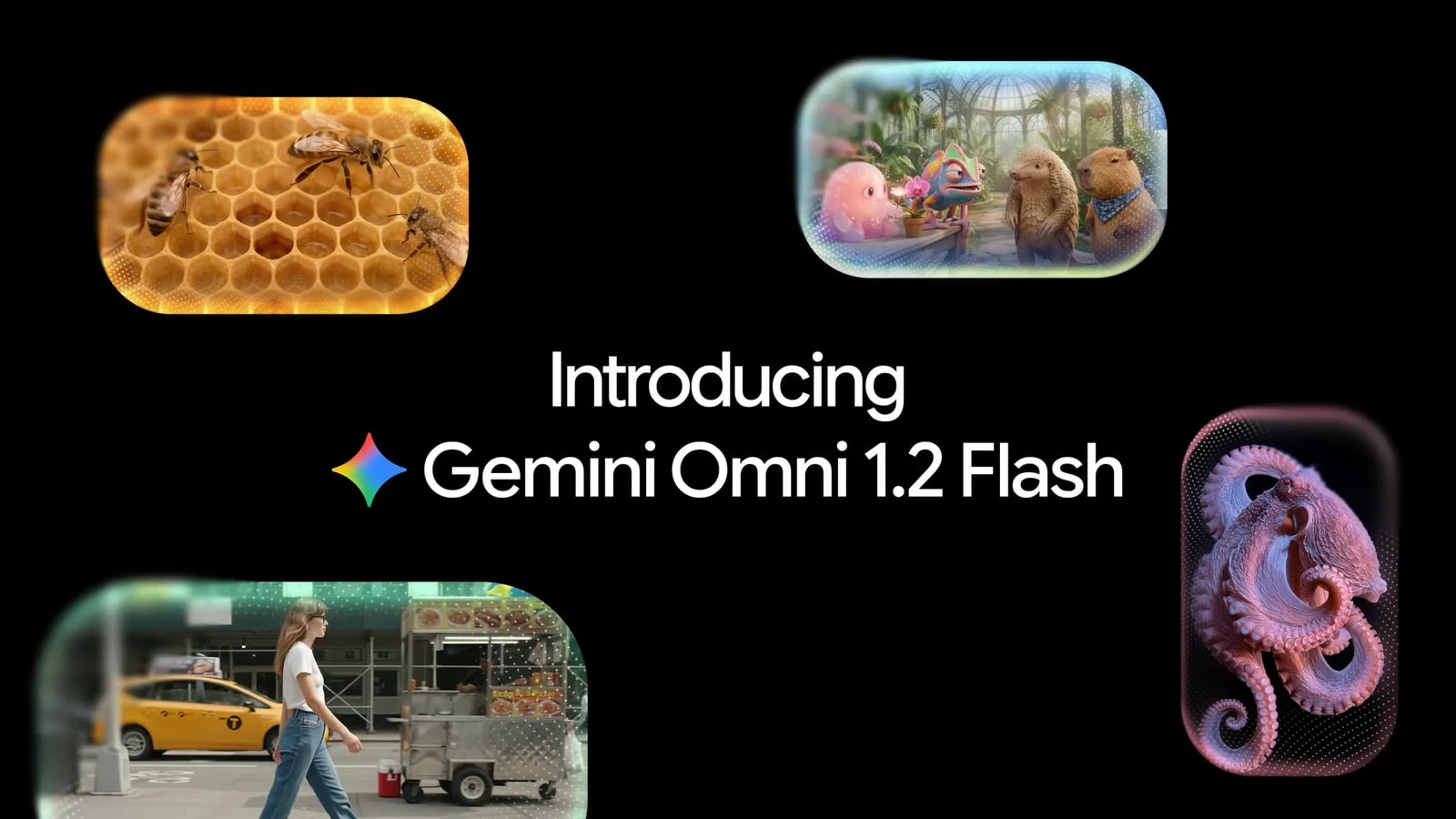
On November 5, 2026, Google made Gemini Omni 1.2 Flash generally available on the Gemini API and Google Cloud. Same day announcement and GA. It is the first Omni model generally available on Google Cloud; on the Gemini API, Omni 1.1 Flash had already been GA since August 27, 2026.
Omni is Google's video generation and conversational editing model with native audio. You prompt with text, images and video; it returns video with speech, music and sound effects, plus text. It runs on the Interactions API only. Google positions it for the everyday videos businesses make in volume: product clips, virtual try-ons and ads. See also our coverage of Google's image model Nano Banana 2.1.
The release is a price and production update, not a new kind of model. Video output drops from $17.50 to $12.00 per 1M tokens, so 720p lands at about $0.07 per second ($4.17 per minute of output). Clips grow from 10 to 15 seconds. From Dec 3, 2026 every 1.1 request auto-routes to 1.2 at the lower rate. The bill-moving choice is resolution: 4K costs 9x 360p per second.
Key Numbers
Gemini Omni 1.2 Flash · Nov 5, 2026
Per second · with audio
At a Glance
| Field | Detail |
|---|---|
| Model id | gemini-omni-1.2-flash |
| Status and date | GA, Nov 5, 2026. Google Cloud retirement Nov 5, 2027 or later. |
| Where | Gemini API via Google AI Studio; Google Cloud Gemini Enterprise Agent Platform (global endpoint); Flow; Google Vids; Gemini app rolling out to Google AI Ultra; Google Ads. Google says it is coming to Gemini for business. |
| Inputs | Text, images, video up to 15 s |
| Outputs | Video with native audio (speech, music, sound effects); plus text |
| API | Interactions API only |
| Length | 3 to 15 s in 1 s steps; first and last frame 3 to 10 s; extension 3 to 10 s per turn up to 30 s total |
| Resolutions | 360p, 720p (default), 1080p and 4K (upscaled); 24 FPS |
| Aspect ratios | 16:9 (default), 9:16 |
| References | Up to 6 images; up to 3 reference videos of up to 3 s for clips up to 10 s, 1 for 11 to 15 s |
| Token limits | Gemini API 131,072 in, 65,536 out; Google Cloud lists 260,640 out |
| Prices | Input $1.50, text output $9.00, video output $12.00 per 1M; no free tier; no Batch |
| Rate limits | Tier 1: 8 RPM / 40 RPD; Tier 2: 16 / 200; Tier 3: 40 / 2,000; free tier not supported |
| Provisioned Throughput | Google Cloud yes; Gemini API no |
| Provenance | SynthID on all outputs; C2PA Content Credentials on Google Cloud |
What Changed Since Omni 1.1
Lineage is short. gemini-omni-flash-preview opened public preview on June 30, 2026 (3 to 10 s, 720p only) and is now shut down. gemini-omni-1.1-flash went GA on the Gemini API on August 27, 2026 with extension, first and last frame interpolation, and 360p to 4K with upscaling. On Google Cloud, 1.1 is still a Preview (gemini-omni-1.1-flash-preview). 1.2 is the production cut.
Longer clips
Native generation and editing move from 10 s to 15 seconds, settable from 3 to 15 s in 1 s steps. Photoroom, quoted by Google Cloud, called 15 s videos "a top user request." QuickFrame AI says 15 s at 1080p lets users create a complete CTV ad in a single generation. First and last frame interpolation still tops out at 10 s; longer with two frames returns an invalid argument error. Extension remains 3 to 10 s per turn (default 10), up to 30 s total, end of clip only.
A 30% price cut
Google says 720p is about $0.07 per second, 30% lessthan Omni 1.1 Flash, "with similar savings at other resolutions." The token rate behind that is $12.00 per 1M video output tokens, down from $17.50. Input and text output prices are unchanged. Full breakdown in Pricing.
Reference adherence and consistency
Google says reference adherence is better: up to 6 reference images (up to 3 per character, up to 2 characters), plus short motion clips up to 3 s. Faces, garments, packaging typography and brand colors stay consistent across camera angles, per Google. Google also claims less drift or morphing from first to last frame, including across interpolation and extension. It shows side-by-side demos; it published no numbers.
Editing in conversation across full 15 s clips
Multi-turn editing runs through the Interactions API with previous_interaction_id, across full 15 s clips, without re-uploading. Google demos include swapping a product or background, changing lighting or weather, and switching aspect ratio.
Speech and camera
Google says speech is more natural: more fluid dialogue, clearer lip-sync, and distinct multi-speaker conditioning. On camera, it claims complex continuous moves (FPV flythroughs, zoom-outs, orbits) with "significantly fewer unwanted jump cuts." No numeric quality deltas.
Production plumbing
This is the first Omni model generally available on Google Cloud, with Provisioned Throughput there (the Gemini API guide says Provisioned Throughput is not supported). Standalone upscaling is new on Google Cloud; 1.1 lacked it there. Paid-tier Gemini API rate limits are doubled. Photoroom's quote on the Google Cloud post mentions general availability and SLAs.
What did not change: same input and text output prices ($1.50 / $9.00 per 1M), same resolutions and aspect ratios, same Interactions API, same 131,072 input limit, still no Batch and no free tier.
Pricing: What a Second, a Clip and a Minute Cost
Official rates from the Gemini API pricing page and Google Cloud generative AI pricing. Token rates are identical across both. Video is billed as output tokens per second of video with audio.
Price Rails · 1.2 vs 1.1
| Resolution | Tokens / s | 1.2 / s | Per 10 s | Per 15 s | Per minute | 1.1 / s |
|---|---|---|---|---|---|---|
| 360p | 1,931 | $0.023 | $0.23 | $0.35 | $1.39 | $0.034 (computed) |
| 720p (default) | 5,792 | $0.070 | $0.70 | $1.04 | $4.17 | ~$0.10 (Google; computed $0.101) |
| 1080p (upscaled) | 8,688 | $0.104 | $1.04 | $1.56 | $6.26 | $0.152 (computed) |
| 4K (upscaled) | 17,376 | $0.209 | $2.09 | $3.13 | $12.51 | $0.304 (computed) |
Per-minute figures are 60 seconds of output, computed from Google's per-token rates (a single generation tops out at 15 s). Omni 1.1 values other than 720p are computed from Google Cloud's published token-per-second counts at 1.1's $17.50 rate. $12.00 vs $17.50 per 1M is about 31% lower; Google rounds to 30%. 4K is 9x 360p and 3x 720p per second.
Worked examples
- A 15 s 720p social ad: 15 × 5,792 = 86,880 tokens = $1.04(Google says "~$1.04").
- One minute of 1080p, e.g. four 15 s clips: $6.26 vs $9.12 on 1.1 (computed).
- One minute at 4K: $12.51, which is 9x the $1.39 for a minute at 360p.
- Iteration on Google Cloud rates: four 15 s 360p drafts plus a 1080p upscale of the winner = $2.44, vs $6.24 for four direct 1080p takes.
- Inputs are small: about $0.0017 per reference image (1,120 tokens at $1.50/M), so six references cost about a cent. Sending a 15 s clip to edit costs up to about $0.13 in input tokens (up to 5,792 tokens per input video second).
Thinking tokens bill at the $9.00 text rate. Google does not say how many a video request uses.
Draft, pick, upscale · one 15 s clip
Lane A · Render high-res directly
Lane B · Draft, pick, upscale
Other draft paths
Draft at 360p or 720p, then upscale keepers. On Google Cloud rates, upscaling never costs more than rendering the target resolution directly. The Gemini API docs describe 1080p and 4K as upscaled via resolution but do not list a separate upscale rate; the draft-then-upscale math above uses Google Cloud rates.
Other video models we have covered, without comparing prices here: WAN 3.0 and Seedance 2.5.
When to Use It, and Migrating from 1.1
Use it if you produce short video in volume: product spins, virtual try-on, merchandise clips, social and CTV ads, explainers. Anyone already on 1.1 should plan for Dec 3, 2026, when routing is forced.
- You do not have to change code. From Dec 3, 2026,
gemini-omni-1.1-flashroutes togemini-omni-1.2-flashand bills at 1.2 rates. - Switch the id now to get 15 s and the lower price about four weeks early.
- Re-test prompts that rely on exact 1.1 behavior. Output will change after the routing date.
- Set
durationexplicitly if you want more than 10 s. - Keep two-frame interpolation at 10 s or less. Longer returns an error.
- Budget for 11 to 15 s clips taking only 1 reference video (3 for clips up to 10 s).
- Draft at 360p or 720p and upscale winners.
- On Google Cloud, 1.1 was a Preview, so 1.2 is the version to put behind an SLA.
Switch now. There is no price or capability reason to wait for the auto-route.
Caveats
- Google published no benchmark scores or numeric quality comparisons for Omni 1.2 Flash; its quality claims are its own and have not been independently verified.
- No generation speed or latency numbers. Google gave none.
- Google says fast sports action, rapid script changes and complex physics still need work.
- Audio references are not open to everyone: the Gemini API does not accept them, and Google Cloud gates them behind an allowlist. Voice editing is not supported.
- English is the only fully supported language; others are not evaluated.
- Editing or extending uploaded videos is unavailable in the EEA, Switzerland and the UK (model-generated videos can be edited and extended). Uploading or editing images of minors is unsupported there. Images of certain recognizable people are unsupported.
- No Batch. No free tier. No system instructions, temperature or negative-prompt parameter (put negatives in the prompt).
- Gemini API and Google Cloud documents differ on output token limits (65,536 vs 260,640) and Provisioned Throughput (unsupported vs supported).
FAQ
- Gemini Omni 1.2 Flash (
gemini-omni-1.2-flash) is Google DeepMind's multimodal model for fast video generation and conversational editing with native audio (speech, music, sound effects). It takes text, images and video and outputs video plus text, via the Interactions API only. - Google announced and made it generally available on November 5, 2026 on the Gemini API and Google Cloud (Gemini Enterprise Agent Platform). Google Cloud lists a retirement date of November 5, 2027 or later.
- Video output is $12.00 per 1M tokens. At Google's token counts, that is about $0.07 per second at 720p ($4.17 per minute of output), $0.023 /$1.39 at 360p, $0.104 /$6.26 at 1080p, and $0.209 /$12.51at 4K. Per-minute figures are 60 seconds of output computed from Google's per-token rates. Input is $1.50 and text output (including thinking) is $9.00 per 1M. No free tier. No Batch.
- Google says video output is 30% lowerthan Omni 1.1 Flash. Token math is $12.00 vs $17.50 per 1M, about 31% lower. At 720p, Google's figure moves from about $0.10 to about $0.07 per second.
- Native generation and editing: 3 to 15 seconds in 1 second steps (up from 10 s on 1.1). First and last frame interpolation is 3 to 10 s only. Extension adds 3 to 10 s per turn (default 10) up to 30 s total, at the end of the clip only.
- Resolutions: 360p, 720p (default), 1080p and 4K (1080p and 4K are upscaled), at 24 FPS. Aspect ratios: 16:9 (default) and 9:16.
- Yes. Outputs include native audio: speech, music and sound effects, billed inside the video output token rate. The Gemini API does not accept audio references, and Google Cloud gates them behind an allowlist. Voice editing is not supported.
- From December 3, 2026, all Gemini API requests to
gemini-omni-1.1-flashroute automatically togemini-omni-1.2-flashwith no code changes, billed at 1.2 rates. Google calls this a 4-week transition window. On Google Cloud, 1.1 remains a Preview (gemini-omni-1.1-flash-preview). Google published no benchmark scores or numeric quality comparisons for Omni 1.2 Flash; its quality claims are its own and have not been independently verified.
Outlook
Things to watch, without date predictions: whether audio references open up (today the Gemini API does not accept them, and Google Cloud gates them behind an allowlist); Gemini for business availability (Google says it is coming); Batch or a cheaper tier for bulk jobs; longer native clips past 15 s; and independent quality measurements. For now, the release you can act on is the one already shipping: lower video tokens, 15 s clips, and Google Cloud GA.
Sources: Google DeepMind announcement, Google Cloud GA post, Gemini API model page, Gemini API pricing, Omni guide, rate limits, Google Cloud model page, Google Cloud pricing.
Continue Reading
- Claude Mythos 5.2: Same Model as Fable, Different Guest List
- Claude Fable 5.2: Anthropic's Long-Horizon Model Gets Cheaper and Pulls Away
- GPT-6 Cyber: OpenAI's Best Exploit Model, at 10x the Price of Sol
- Gemini 4 Carbon: Google's New Table Leader, Gated to Cyber Defenders
- GPT-6.1 Terra: Sol-Class Computer Use at Half the Price