
Claude Opus 4.6: New Benchmarks, Pricing, and Features
A comprehensive analysis of Anthropic's Claude Opus 4.6 — featuring a 1 million token context window, agent teams for parallel coordination, 68.8% on ARC AGI 2, 500+ zero-day vulnerability discoveries, and enterprise integration with Microsoft 365.

On February 5, 2026, Anthropic fundamentally altered the enterprise AI landscape with the release of Claude Opus 4.6. This latest iteration of the flagship Opus line represents more than a mere incremental update; it signals a shift toward massive-context processing and parallel agentic coordination. With a groundbreaking 1 million token context window in beta and a pricing structure that maintains parity with its predecessor for standard tasks, Claude Opus 4.6 targets high-stakes technical analysis and complex software engineering. The model achieves an 83% improvement on ARC AGI 2 reasoning tasks compared to Opus 4.5 and introduces "agent teams," a feature allowing parallel multi-agent coordination for reducing latency in complex workflows.
This article provides a deep technical analysis of the Claude Opus 4.6 release, examining its architecture, the implications of its benchmarks, and its integration into enterprise environments. We will explore how it identifies over 500 previously undiscovered security vulnerabilities in open-source code and why its performance on the Claude Opus 4.6 technical report sets a new standard for frontier models.
Technical Specifications and the 1 Million Context Window
The most significant architectural shift in Claude Opus 4.6 is the introduction of a 1 million token context window. This capability addresses a critical bottleneck in Large Language Model (LLM) deployment: "context rot." Previous models often suffered from performance degradation as conversations or document inputs expanded. In the "needle in a haystack" evaluation (MRCR v2), which tests retrieval accuracy across vast datasets, Claude Opus 4.6 achieved 76% accuracy on the 8-needle 1 million token variant. For comparison, Claude Sonnet 4.5 achieved only 18.5% on the same benchmark. This qualitative shift allows legal firms and financial institutions to process entire case histories or codebases in a single interaction without fragmentation.
To manage the computational load of this massive context, Anthropic introduced a tiered pricing strategy. While the base Claude Opus 4.6 price remains competitive, prompts exceeding 200,000 tokens incur premium rates. This structure reflects the immense resources required to maintain coherence over millions of tokens. Additionally, the model supports up to 128,000 output tokens—double the limit of Sonnet 4.5—enabling the generation of comprehensive system designs or multi-chapter documents in a single pass.

Claude Opus 4.6 pricing, performance, and capabilities overview. Source: llm-stats.com
The model also features "adaptive thinking." Instead of developers manually setting token budgets, the model analyzes the prompt's complexity and automatically allocates the necessary "thinking" tokens. This eliminates the guesswork between latency and performance. At medium effort levels, Opus 4.6 matches the best performance of Sonnet 4.5 on software engineering tasks while consuming 76% fewer output tokens, offering a distinct efficiency advantage for Claude Opus 4.6 API users.
Benchmarks: Reasoning, Coding, and Agentic Dominance
Claude Opus 4.6 benchmarks indicate a decisive lead in reasoning and agentic tasks. On the ARC AGI 2 benchmark, which tests abstract reasoning rather than memorization, the model scored 68.8%. This is a staggering improvement over Opus 4.5 (37.6%) and well ahead of competitors like Gemini 3 Pro (45.1%) and GPT-5.2 Pro (54.2%). This suggests the model has moved closer to general reasoning capabilities essential for novel problem-solving.

Claude Opus 4.6 benchmark results across key evaluation datasets, including AIME 2025, GPQA, SWE-Bench Verified, ARC-AGI v2, Terminal-Bench 2.0, and more. Source: llm-stats.com
In the domain of software engineering, the model continues to excel. On Terminal-Bench 2.0, capable of evaluating command-line coding tasks, Opus 4.6 scored 65.4%, surpassing both Gemini 3 Pro and GPT-5.2. Practical application supports these numbers; in trials with cybersecurity firm SentinelOne, the model managed a multi-million-line codebase migration, planning and adapting its strategy like a senior engineer.
For economically valuable knowledge work, the GDPval-AA benchmark rates Opus 4.6 at 1,606 Elo points. This score is approximately 144 points higher than OpenAI's GPT-5.2. This metric is crucial for enterprise decision-makers, as it correlates directly with the model's ability to handle complex, multi-step professional tasks in finance and law. The model also demonstrated a 90.2% score on the BigLaw Bench, cementing its utility for legal domain expertise.
The Agent Teams Revolution and Parallel Processing
Perhaps the most transformative feature detailed in the Claude Opus 4.6 technical report is "agent teams." Traditional agentic workflows operate sequentially: Agent A finishes a task, then hands it to Agent B. This creates bottlenecks. The new architecture allows developers to split work across multiple agents that coordinate in parallel.
This is not theoretical. In internal cybersecurity testing, Opus 4.6 with agent teams produced superior results in 38 out of 40 investigations compared to single-stream Opus 4.5 models. A real-world deployment at Rakuten saw the model autonomously close 13 IT issues and assign 12 others to the correct human staff in a single day. The system managed a 50-person organization across 6 repositories, demonstrating judgment on when to act autonomously and when to escalate.
This parallel orchestration capability is available via the Claude Opus 4.6 API and represents a fundamental change in how businesses automate complex operations. It moves AI from a chatbot interface to an organizational infrastructure layer capable of managing distinct workflows simultaneously.
Security, Safety, and Microsoft 365 Integration
Security researchers have utilized Claude Opus 4.6 to identify over 500 previously undiscovered zero-day vulnerabilities in open-source software. The model, equipped with basic tools like debuggers but no specific guidance, found critical flaws in widely used libraries such as GhostScript and OpenSC. It demonstrated advanced reasoning by referencing Git commits to find patterns that static analysis tools missed. To prevent misuse, Anthropic has implemented real-time detection systems to block malicious traffic, acknowledging the dual-use nature of this capability.
Anthropic has also aggressively expanded its ecosystem integration. Claude Opus 4.6 is now embedded directly into Microsoft 365. Users can generate PowerPoint presentations with correct template formatting directly within the application, or use the model in Excel for complex financial analysis. This integration lowers the barrier to entry, allowing non-technical staff to leverage the model's 1,606 Elo reasoning power without leaving their primary productivity tools.
On the safety front, the model operates under a newly revised 2026 Constitution. This framework treats the model as a "conscientious objector," prioritizing safety and human oversight above helpfulness. It is designed to refuse harmful requests, even if they originate from Anthropic's own researchers, ensuring alignment in high-stakes environments.
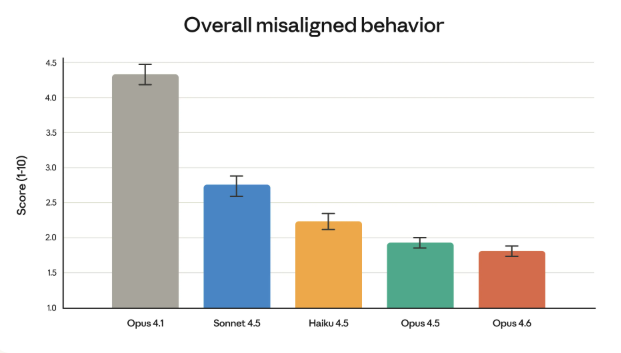
Overall misaligned behavior scores across Claude model generations. Opus 4.6 achieves the lowest misalignment rate, outperforming Opus 4.5, Haiku 4.5, Sonnet 4.5, and Opus 4.1. Source: Anthropic
Quick Takeaways
- 1 Million Token Context: The beta feature achieves 76% accuracy on "needle in a haystack" retrieval tasks, solving context rot.
- ARC AGI 2 Dominance: A score of 68.8% represents an 83% improvement in abstract reasoning over Opus 4.5.
- Agent Teams: New parallel architecture allows multiple agents to coordinate simultaneously, drastically improving complex workflow efficiency.
- Zero-Day Discovery: The model autonomously identified over 500 security vulnerabilities in open-source code.
- Pricing Parity: Standard input/output costs remain $5/$25 per million tokens, identical to the previous generation.
- Enterprise Integration: Native embedding in Microsoft PowerPoint and Excel streamlines corporate adoption.
- Economic Value: Scored 1,606 Elo on GDPval-AA, outperforming GPT-5.2 and Gemini 3 Pro on economically valuable tasks.
Conclusion
Claude Opus 4.6 establishes a new ceiling for frontier AI models. By combining a 1 million token context window with the parallel processing power of agent teams, Anthropic has moved beyond simple chat interactions toward genuine autonomous work. The model's ability to uncover hundreds of zero-day vulnerabilities validates its reasoning depth, while its integration into Microsoft 365 ensures these capabilities are accessible to the average knowledge worker.
For enterprise leaders and developers, the path forward is clear. The significant boost in reasoning capabilities—evidenced by the ARC AGI 2 and GDPval-AA scores—justifies the migration for high-complexity tasks. However, the introduction of tiered pricing for extended context requires a strategic approach to resource allocation. Organizations should begin piloting the agent teams capability immediately to capitalize on the efficiency gains of parallel workflows.
Questions
Frequently Asked Questions
- Anthropic released Claude Opus 4.6 on February 5, 2026. It is available immediately through the Claude API, Claude.ai, and major cloud platforms like AWS Bedrock and Google Vertex AI.
- For standard context (under 200k tokens), the price remains $5 per million input tokens and $25 per million output tokens, matching Opus 4.5. However, prompts exceeding 200k tokens are charged a premium rate of $10 per million input and $37.50 per million output tokens.
- The model introduces a beta capability for a 1 million token context window. This allows for the processing of massive codebases or extensive legal documentation in a single prompt.
- It is a market leader. On Terminal-Bench 2.0, it scored 65.4%, beating GPT-5.2. On SWE-bench Verified, it scored 80.8%, effectively matching its predecessor while offering 76% greater efficiency at medium effort levels.
- Agent Teams is a new architectural feature that allows multiple Claude instances to work in parallel rather than sequentially. This reduces latency and improves performance on complex tasks, as demonstrated by its superior performance in cybersecurity investigations.
Continue Reading