
Kimi 2.5: Inside Moonshot AI's Trillion-Parameter Agent
A comprehensive analysis of Moonshot AI's Kimi K2.5 — the industry's first native multimodal trillion-parameter model with self-directed agent swarm technology, 256K context window, and revolutionary parallel sub-agent orchestration.

Moonshot AI has fundamentally altered the open-source landscape with the release of Kimi K2.5 on January 27, 2026. This model is not merely an iterative update—it represents the industry's first native multimodal trillion-parameter model designed with sophisticated agentic capabilities at its core. Kimi 2.5 integrates vision and language understanding into a unified framework, supporting both instant interaction and deep reasoning modes.
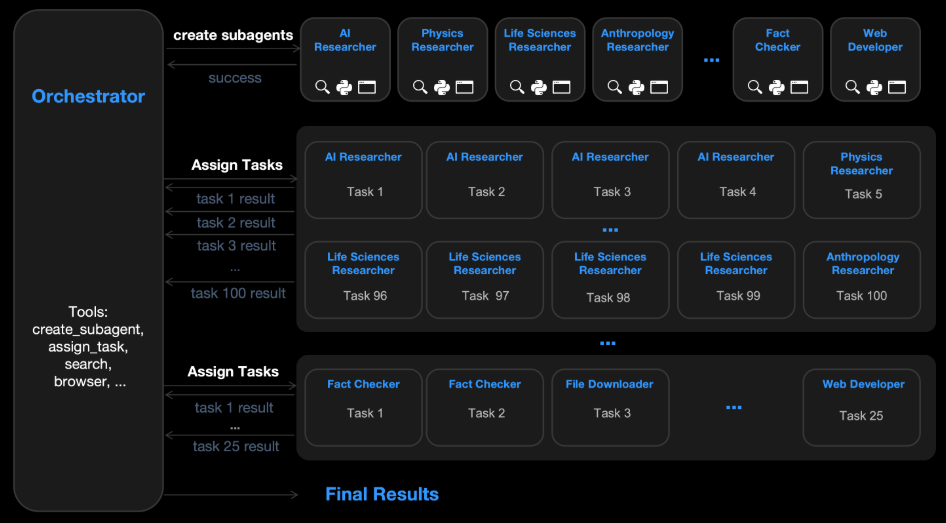
The defining feature of this release is the "self-directed agent swarm" paradigm. This architecture coordinates up to 100 parallel sub-agents capable of executing 1,500 tool calls simultaneously. This approach reduces execution time by up to 4.5× compared to traditional single-agent setups. For developers and enterprises, Kimi 2.5 offers a cost-effective, high-performance alternative to proprietary models like GPT-5.2. This article analyzes the architecture, pricing, and technical specifications that make Kimi 2.5 a critical tool for modern AI deployment.
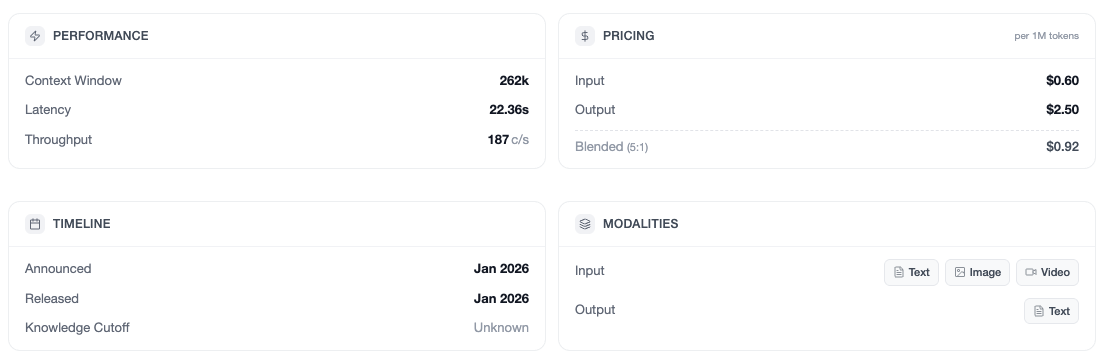
Kimi K2.5 Key Specifications
View Kimi K2.5 details on LLM Stats ->
Technical Architecture and Design Specifications
The architecture of Kimi 2.5 builds upon the K2 base but introduces native multimodal capabilities that were previously absent. The model utilizes a Mixture-of-Experts (MoE) structure with 1 trillion total parameters. Crucially, only 32 billion parameters activate per token during inference. This sparse activation allows the model to retain massive knowledge capacity while maintaining the speed and cost efficiency of smaller dense models.
The framework consists of 61 layers and employs Multi-head Latent Attention (MLA). This mechanism improves memory efficiency and supports a massive Kimi 2.5 context window of 256,000 tokens. Unlike competitors that bolt on vision capabilities as an afterthought, Kimi 2.5 uses a proprietary MoonViT vision encoder. This 400M-parameter encoder processes images and videos natively, projecting compressed visual features directly into the language backbone.
Development involved continued pretraining on the K2 Base foundation. The full unquantized model requires approximately 630GB of disk space. However, optimization is a key focus: the 1.8-bit quantized variant shrinks this requirement to 230GB. This ~80% reduction makes local deployment feasible on high-end consumer hardware while maintaining robust performance.
For deep technical details, see:
*Kimi K2.5's MoE architecture*
Training Data and Optimization Innovations
The Kimi 2.5 paper and technical documentation describe a training process involving 15 trillion mixed visual and text tokens. This dataset includes high-quality web text, scientific publications, code, and interleaved image-text data. Moonshot AI utilized the MuonClip optimizer to manage this scale, combining token-efficient optimization with weight clipping to ensure zero training instability.
Training used a curriculum starting with a constant learning rate followed by cosine decay. Post-training involved Quantization-Aware Training (QAT) using INT4 precision. This enables native INT4 inference, doubling generation speed without sacrificing quality. All reported benchmarks reflect this quantized performance, providing a transparent view of real-world capabilities.
A standout innovation is Parallel-Agent Reinforcement Learning (PARL). This framework trains the model to decompose complex tasks into parallel subtasks, rewarding strategies that minimize wall-clock time rather than step count. This training method enables the model's distinctive swarm intelligence.
Multimodal Vision and Agent Swarm Technology
Kimi 2.5 distinguishes itself through Agent Swarm technology. This capability shifts the paradigm from single-agent scaling to coordinated multi-agent execution. When a user assigns a complex objective, the model acts as an orchestrator—spinning up specialized sub-agents (e.g., a "Fact Checker" or "Physics Researcher") to work simultaneously.
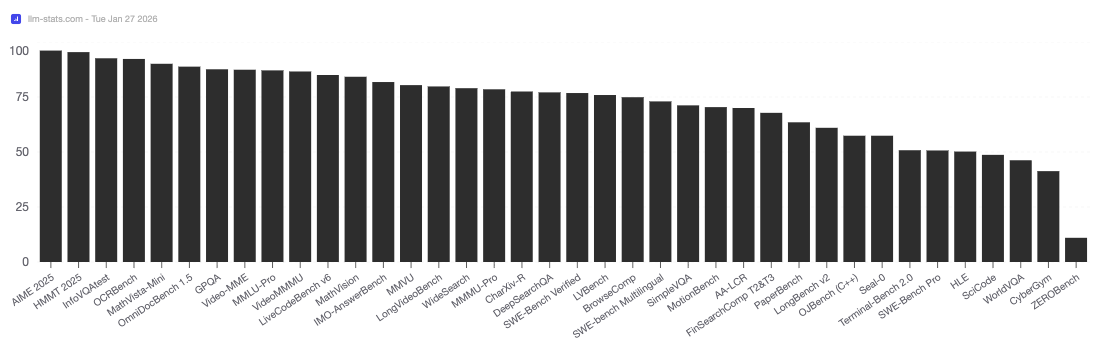
In internal evaluations, this swarm approach achieved an 80% reduction in end-to-end runtime for long-horizon tasks. On the WideSearch benchmark, agent swarm mode improved accuracy from 72.7% to 79.0%. The model doesn't just work faster; it validates outputs via multiple specialized agents.
Visual reasoning is equally robust. Kimi 2.5 achieved 78.5% on MMMU-Pro and 86.6% on VideoMMMU, surpassing GPT-5.2 and Claude Opus 4.5 in video reasoning tasks. Practical applications include vision-to-code generation: the model can analyze a video recording of a user interface and generate functional React or Tailwind CSS code, then inspect its own visual output to correct discrepancies—significantly accelerating frontend development.
Explore these capabilities via the Kimi web interface.
View detailed benchmark results ->
Pricing, Latency, and Deployment
Understanding Kimi 2.5 pricing is essential for enterprise adoption. Moonshot AI offers aggressive rates compared to US-based competitors. Through API providers like Fireworks AI, the model costs:
- $0.60 per 1M uncached input tokens
- $2.50 per 1M output tokens
- $0.30 per 1M cached input tokens
This pricing makes high-volume agentic workflows economically viable.

See pricing and available providers ->
However, deployers must consider Kimi 2.5 latency. In Thinking Mode, response times typically range from 8 to 25 seconds. Faster models like GPT-5.1 Instant respond in 2 to 8 seconds. This higher latency is the trade-off for deep reasoning and swarm coordination. For interactive chatbots that require instant responses, this may be a constraint.
The model is open-source under a modified MIT license, with weights available on Hugging Face for local deployment. Running locally requires significant hardware: a practical setup for 5+ tokens/second typically needs about 247GB of unified memory. For teams without that infrastructure, cloud API options provide immediate access.
Quick Takeaways
- Release Date: Launched Jan 27, 2026, as the first multimodal trillion-parameter open-source model.
- Swarm Intelligence: Coordinates up to 100 sub-agents, reducing runtime by ~80% for long tasks.
- Context Window: Supports up to 256,000 tokens across thinking and instant modes.
- Visual Coding: Converts UI screenshots/videos into functional code with self-correction loops.
- Cost Efficiency: Kimi 2.5 price starts at ~$0.60 / 1M input tokens, undercutting proprietary rivals.
- Open Access: Available via API or local deployment with INT4 quantization.
- Performance: Beats or matches Gemini 3 Pro and GPT-5.2 on key coding and video understanding benchmarks.
Conclusion
Kimi 2.5 is a pivotal proof point that open-source AI can compete with proprietary giants. By combining a trillion-parameter MoE architecture with native multimodality and agent swarm capabilities, Moonshot AI has delivered a versatile tool for developers and researchers. The Kimi 2.5 release democratizes access to advanced reasoning and visual processing, reducing barriers often associated with frontier models.
Organizations looking to integrate deep reasoning into their workflows should evaluate Kimi 2.5 immediately—whether through low-cost APIs or local deployment. Latency trade-offs are balanced by reasoning depth and the ability to automate complex, multi-step tasks autonomously.
Questions
Frequently Asked Questions
- Through providers like Fireworks AI, Kimi 2.5 costs $0.60 per 1M uncached input tokens and $2.50 per 1M output tokens. Cached inputs are priced at $0.30 per 1M tokens, making high-volume agentic workflows economically viable.
The model supports a context window of 256,000 tokens. Performance degradation is reported beyond ~150,000 tokens, so hierarchical processing is recommended for ultra-long documents.
- The technical report is available on the Moonshot AI GitHub repository: https://github.com/MoonshotAI/Kimi-K2/blob/main/tech_report.pdf
Moonshot AI released Kimi K2.5 on January 27, 2026, making it the first native multimodal trillion-parameter open-source model.
Kimi 2.5 prioritizes reasoning depth over speed. In Thinking Mode, expect 8–25 seconds latency; Instant Mode is faster for simpler tasks. This trade-off enables deep reasoning and swarm coordination capabilities.
Continue Reading