
Claude Opus 4.6 vs GPT-5.3 Codex: The Definitive Frontier Battle
In-depth comparison of Claude Opus 4.6 and GPT-5.3 Codex across benchmarks, pricing, context windows, agentic capabilities, and real-world performance. Discover which frontier AI model best fits your needs.

On February 5, 2026, the artificial intelligence landscape shifted fundamentally. Two industry titans simultaneously released their flagship frontier models, marking a departure from general-purpose scaling toward specialized architectural philosophies. Anthropic unveiled Claude Opus 4.6, a reasoning powerhouse with a 1 million token context window, while OpenAI launched GPT-5.3-Codex, an agentic system optimized for speed and autonomy.
For enterprise leaders and developers, the choice between claude opus 4.6 vs gpt 5.3 codex is no longer about which model is "smarter" in the abstract. It is about choosing the right cognitive engine for specific workflows. Anthropic has doubled down on deep reasoning and "adaptive thinking" for complex knowledge work, while OpenAI has prioritized "cognitive density" and execution speed for technical agents. This analysis dissects the architectural decisions, benchmark performance, and practical applications of both models to help you determine which system aligns with your strategic needs.
Architectural Philosophy: Reasoning Depth vs. Cognitive Density
The core differentiator in the claude opus 4.6 vs gpt 5.3 codex debate lies in how each model approaches problem-solving. Anthropic designed Opus 4.6 around "adaptive thinking." This architecture allows the model to autonomously determine when extended reasoning is required. Instead of a binary switch between thinking and non-thinking modes, Opus 4.6 evaluates contextual cues to decide if deeper computation will yield a better result. This effectively solves the "context rot" issue, where model performance typically degrades as conversations lengthen. By utilizing enhanced attention mechanisms, Opus 4.6 maintains high retrieval accuracy even across its massive 1 million token context.
In contrast, OpenAI optimized GPT-5.3-Codex for cognitive density and efficiency. Rather than maximizing parameter counts, OpenAI focused on packing more reasoning capability into a faster inference stack. Notably, the development of GPT-5.3-Codex was recursive; early versions of the model were used to debug the training pipeline and optimize the deployment infrastructure. This "self-hosting" approach resulted in a model that excels at understanding developer intent and executing tasks rapidly. OpenAI prioritizes an agentic workflow where the model acts as an autonomous engineer rather than just a text generator.
This philosophical split creates a clear distinction for users. If your workflow requires navigating sprawling documentation or legal synthesis, Opus 4.6's adaptive depth is superior. If your goal is rapid, iterative software development or terminal operations, the architectural efficiency of GPT-5.3-Codex offers a distinct advantage.
Benchmarks: The Data Behind the Models
When analyzing claude opus 4.6 vs gpt 5.3 codex benchmarks, the results reveal specialized dominance rather than a single winner. The numbers reflect the design priorities of their respective creators.
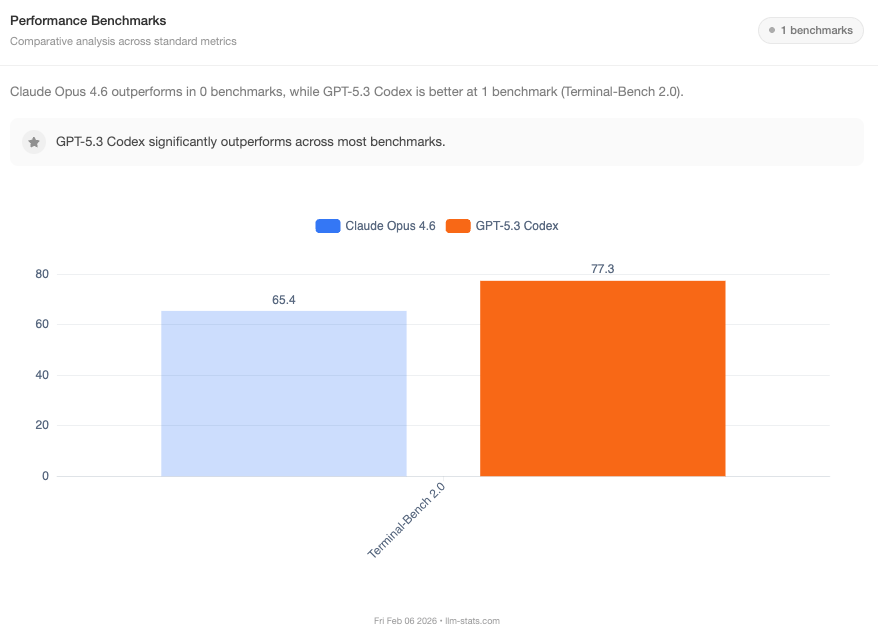
Head-to-head performance comparison between Claude Opus 4.6 and GPT-5.3 Codex on Terminal-Bench 2.0. Source: llm-stats.com
On technical execution, GPT-5.3-Codex proves formidable. In Terminal-Bench 2.0, which evaluates agentic coding capabilities in command-line environments, GPT-5.3-Codex achieved 77.3% accuracy, significantly outpacing Opus 4.6, which scored 65.4%. This 12-percentage-point gap highlights OpenAI's focus on infrastructure and system administration tasks. Furthermore, on OSWorld-Verified, a benchmark for computer-use tasks, GPT-5.3-Codex reached 64.7% accuracy, approaching human baselines and solidifying its position as a superior navigational agent.
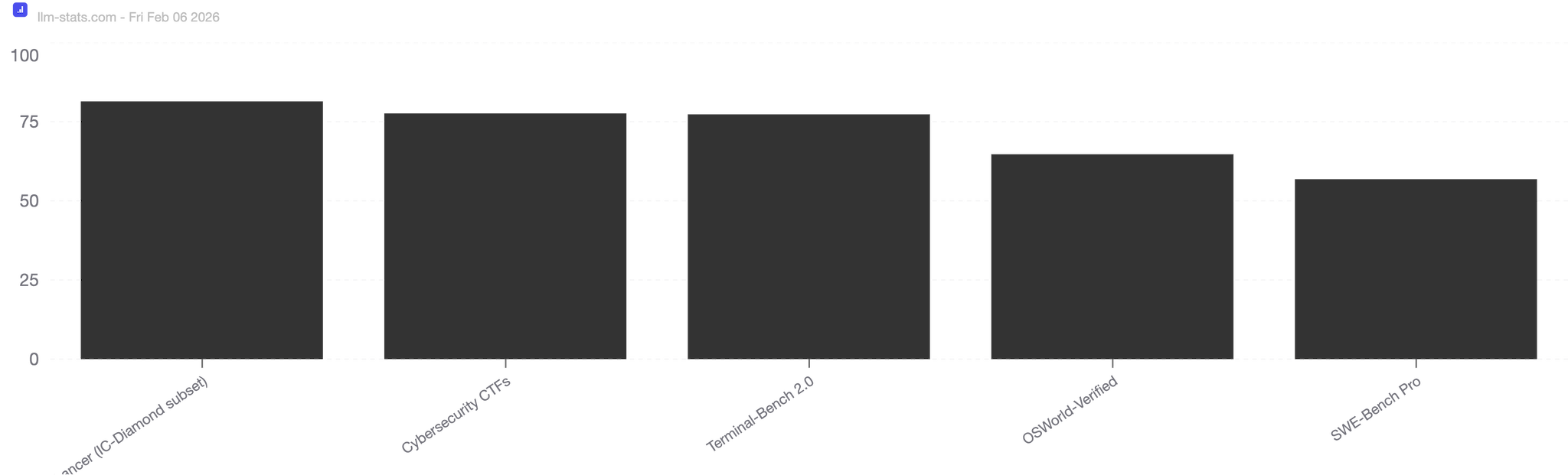
GPT-5.3 Codex benchmark results across key evaluation datasets. Source: llm-stats.com
However, the narrative flips for professional knowledge work. On the GDPval-AA benchmark, which measures performance across economically valuable tasks in finance and law, Claude Opus 4.6 scored 1,606 Elo points. This represents a massive 144-point lead over GPT-5.2, indicating that Opus 4.6 outperforms its competition approximately 70% of the time in high-level professional scenarios. Additionally, on the MRCR v2 "needle-in-a-haystack" test, Opus 4.6 maintained 76% accuracy at 1 million tokens, whereas previous models like Sonnet 4.5 dropped to 18.5%.

Claude Opus 4.6 benchmark results across key evaluation datasets. Source: llm-stats.com
For developers looking at the claude opus 4.6 vs gpt 5.3 codex technical report data, the choice is dictated by the domain. GPT-5.3-Codex wins on pure coding autonomy and terminal operations. Claude Opus 4.6 dominates in complex, context-heavy analysis and professional reasoning.
Agentic Capabilities: Teams vs. Autonomous Endurance
The claude opus 4.6 vs gpt 5.3 codex comparison extends into how these models handle agentic workflows. Anthropic introduced a "agent teams" feature with Opus 4.6, currently in research preview. This allows developers to deploy multiple specialized agents that work in parallel. Instead of a single stream of thought, an organization can spin up a "financial analyst" agent and a "legal review" agent to collaborate on a single project. Anthropic reports that in blind cybersecurity investigations, this multi-agent approach produced superior results in 38 out of 40 trials compared to single-agent setups.
OpenAI takes a different route, focusing on long-horizon persistence. GPT-5.3-Codex is designed to execute tasks that last longer than a single day without losing the thread of the project. OpenAI demonstrated this by having the model autonomously build complex browser games over millions of tokens, accepting "steerability" prompts like "fix the bug" without unraveling previous code structures. This ability to maintain continuity over multi-day coding sessions changes the scope of what autonomous agents can theoretically achieve.
The distinction here is between coordination and endurance. Claude Opus 4.6 excels at breaking complex tasks into subtasks for parallel execution by agent teams. GPT-5.3-Codex excels at grinding through long, singular engineering objectives with high reliability and "perfect recall" across its context window.
Context, Speed, and Efficiency
The battle of claude opus 4.6 vs gpt 5.3 codex context window specifications is significant. Claude Opus 4.6 introduces a staggering 1 million token context window in beta. This capacity allows organizations to ingest entire codebases, years of regulatory filings, or massive datasets in a single prompt. To manage this, Anthropic introduced "context compaction," a feature that summarizes older conversation turns to keep the context relevant without hitting hard limits.
GPT-5.3-Codex offers a smaller 400K token context window. However, OpenAI argues that this size is the optimal balance point for maintaining inference speed. GPT-5.3-Codex runs 25% faster than previous Codex models. This reduced latency is critical for real-time coding assistants and interactive agents where waiting for a response breaks the user's flow.
When considering claude opus 4.6 vs gpt 5.3 codex latency, OpenAI holds the edge for speed-sensitive tasks. However, for deep research where the model must synthesize hundreds of documents, Claude's larger context window and "high effort" reasoning mode provide a functional capability that speed cannot replicate.
Pricing and Enterprise Positioning
The claude opus 4.6 vs gpt 5.3 codex pricing structures reflect their market positioning. Claude Opus 4.6 maintains a premium pricing model: $5 per million input tokens and $25 per million output tokens for standard requests. For prompts exceeding 200K tokens, the price doubles. This aligns with Anthropic's target audience—enterprise legal, finance, and research firms where the cost of the query is negligible compared to the value of accurate analysis.
GPT-5.3-Codex targets broad developer adoption. While exact enterprise API pricing varies, comparative data suggests OpenAI aims for lower per-token costs to encourage high-volume agentic loops. The model is immediately available via the Codex app and ChatGPT, prioritizing accessibility.
For enterprise buyers, the claude opus 4.6 vs gpt 5.3 codex API decision often comes down to the value of the output. If the task involves high-stakes contract review (where Opus scores 90.2% on BigLaw Bench), the higher cost is justified. For continuous integration pipelines or automated testing agents, the efficiency and lower likely cost of GPT-5.3-Codex make it the logical economic choice.
Quick Takeaways
- Reasoning vs. Speed: Claude Opus 4.6 prioritizes deep, adaptive reasoning; GPT-5.3-Codex prioritizes inference speed (25% faster) and coding efficiency.
- Context Wars: Opus 4.6 boasts a massive 1 million token context window. GPT-5.3-Codex offers 400K tokens but claims "perfect recall" with lower latency.
- Benchmark Leaders: GPT-5.3-Codex wins on Terminal-Bench (77.3%). Opus 4.6 dominates professional work on GDPval-AA (1606 Elo).
- Agentic Approach: Anthropic focuses on "Agent Teams" for parallel coordination. OpenAI focuses on long-horizon, multi-day task endurance.
- Pricing Strategy: Claude maintains premium pricing ($15/$75 for deep context) targeting high-value enterprise tasks. OpenAI targets volume and accessibility.
- Best for Devs: GPT-5.3-Codex is the superior tool for terminal operations and infrastructure.
- Best for Professionals: Claude Opus 4.6 is the superior tool for legal, financial, and complex analytical synthesis.
Conclusion
The release of claude opus 4.6 vs gpt 5.3 codex proves that the "one model to rule them all" era is over. We have entered a phase of divergent specialization. Anthropic has successfully positioned Claude Opus 4.6 as the premier choice for "thinking" tasks—complex analysis, legal reasoning, and multi-agent coordination where depth is paramount. It is the tool for the analyst, the lawyer, and the strategist.
Conversely, OpenAI has cemented GPT-5.3-Codex as the ultimate engine for "doing." Its speed, terminal proficiency, and ability to execute long-running software engineering tasks make it the definitive choice for technical implementation and autonomous development.
For the forward-thinking organization, the strategy should not be to choose one winner. Instead, you must integrate both: leverage GPT-5.3-Codex for your build pipelines and technical infrastructure, and deploy Claude Opus 4.6 for your strategic analysis and decision-making workflows.
Questions
Frequently Asked Questions
Claude Opus 4.6 costs $5 per million input tokens and $25 per million output tokens for standard requests, with prices doubling for contexts over 200K tokens. GPT-5.3-Codex is generally more affordable, priced around $1.25 per million input tokens, optimizing it for high-volume coding tasks.
GPT-5.3-Codex is generally superior for pure coding and system administration, scoring 77.3% on Terminal-Bench. However, Claude Opus 4.6 is exceptional for large-scale code migration and understanding massive codebases due to its 1 million token context window.
Yes, Claude Opus 4.6 features a 1 million token context window (currently in beta). It uses “adaptive thinking” and context compaction to maintain high retrieval accuracy (76% on needle-in-a-haystack tests) across this vast amount of data.
Agent Teams is a feature allowing developers to spawn multiple sub-agents that work in parallel on different parts of a problem. This contrasts with GPT-5.3-Codex's approach, which focuses on a single agent sustaining a long-horizon task over several days.
Both models have high security standards. OpenAI classifies GPT-5.3-Codex as "High capability" for cyber tasks and employs a comprehensive safety stack. Anthropic's Opus 4.6 showed superior defensive capabilities in blind cybersecurity trials, successfully mitigating threats in 38 of 40 investigations.
Continue Reading