
GPT-5.3 Codex: Agentic AI & The Future of Coding
A comprehensive analysis of OpenAI's GPT-5.3 Codex — the first model instrumental in its own creation, featuring a 400K context window, 128K output limit, state-of-the-art coding benchmarks, and agentic capabilities that redefine the developer experience.

OpenAI has officially redefined the landscape of artificial intelligence with the gpt 5.3 codex release. Announced in early February 2026, this model represents a fundamental shift from specialized coding assistants to general-purpose agents capable of executing complex professional workflows. No longer limited to snippet generation, GPT-5.3-Codex operates as a comprehensive collaborator that can plan, reason, and execute tasks across the entire software development lifecycle.
The model distinguishes itself as the first AI instrumentally involved in its own creation. It combines the frontier coding performance of previous iterations with the broad reasoning of the GPT-5 series. With a massive 400,000 token context window and a breakthrough 128,000 token output limit, it enables developers to generate entire software systems in single interactions. This article analyzes the gpt 5.3 codex technical report, exploring its architecture, gpt 5.3 codex benchmarks, and the implications for enterprise productivity. We will also detail gpt 5.3 codex pricing and availability to help you understand how this tool fits into your workflow.
The Evolution of Agentic Coding Intelligence
The path to GPT-5.3-Codex was paved by an aggressive iteration schedule following the GPT-5 launch in August 2025. OpenAI moved away from static tools toward dynamic agents that understand intent and context. The initial Codex research preview established the vision, but gpt 5.3 codex realizes it by introducing dynamic reasoning capabilities.
Earlier models relied on static routing. They allocated computation at the start of a request. GPT-5.3-Codex changes this paradigm. It utilizes inline decision-making. The model can recognize mid-task that a problem requires deeper analysis. It then automatically adjusts its computational investment. This mirrors how human experts approach complex engineering challenges. Internal data shows that on complex tasks, the model spends significantly longer reasoning and testing code compared to base GPT-5, resulting in higher success rates.
This evolution is not just about raw power. It is about usability. The release of the Codex app for macOS fundamentally changes how developers orchestrate agents. You can now manage parallel work streams, review diffs, and maintain security through sandboxed environments. This shift from chat interfaces to a dedicated "command center" signals that AI has graduated from a novelty to a core infrastructure component for professional developers.
Technical Architecture and Model Innovations
The gpt 5.3 codex technical report reveals a unified architecture designed for high-density cognitive efficiency. Co-designed with NVIDIA on GB200 NVL72 systems, the model leverages infrastructure that delivers 4x faster training performance than previous generations. This hardware partnership allowed OpenAI to train and evaluate new versions at roughly three-day intervals.
A standout feature is the gpt 5.3 codex context window. While competitors push for million-token windows, OpenAI optimized a 400,000 token window with a "Perfect Recall" attention mechanism. This prevents information loss in the middle of long prompts. More importantly, the model boasts a 128,000 token output limit. This is critical for agentic workflows. It eliminates the need for piecemeal code generation. Developers can now request comprehensive documentation, multi-file implementations, and complete libraries in a single output.
The model also introduces "first-class agentic operations." Tool use, API calls, file navigation, and self-directed testing are native capabilities. They are not bolted-on features. This architectural choice allows the model to function as a general-purpose collaborator. It can perform research, synthesize data, and execute decisions across professional domains beyond strict coding tasks.
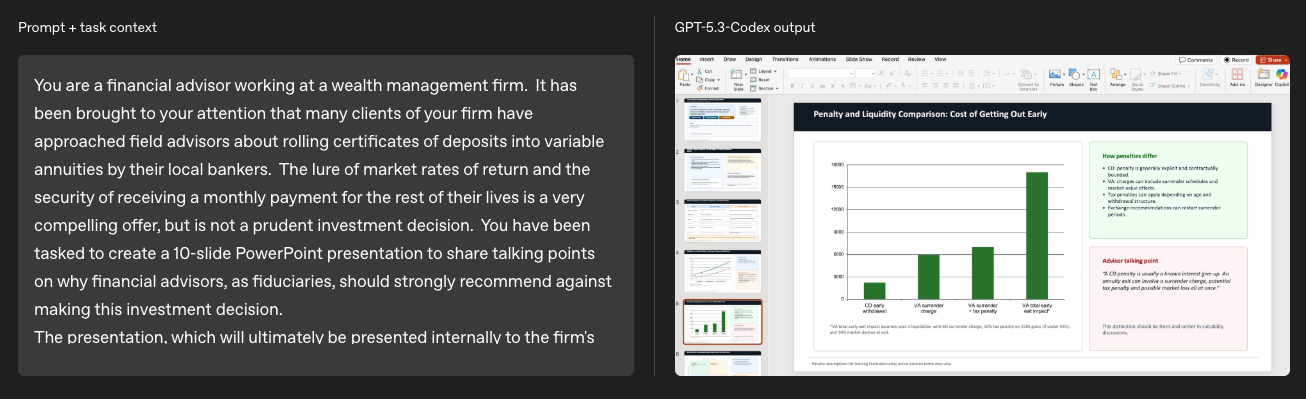
An example of GPT-5.3 Codex autonomously generating a complete PowerPoint presentation from a complex prompt, demonstrating its agentic capabilities beyond simple code generation.
Benchmarks and Real-World Performance
The gpt 5.3 codex benchmarks demonstrate state-of-the-art performance on rigorous industry standards. On SWE-Bench Pro, which tests real-world software engineering across multiple languages, the model achieved 56.8% accuracy. This surpasses previous iterations while using fewer tokens. This efficiency suggests genuine reasoning advancements rather than simple computational scaling.
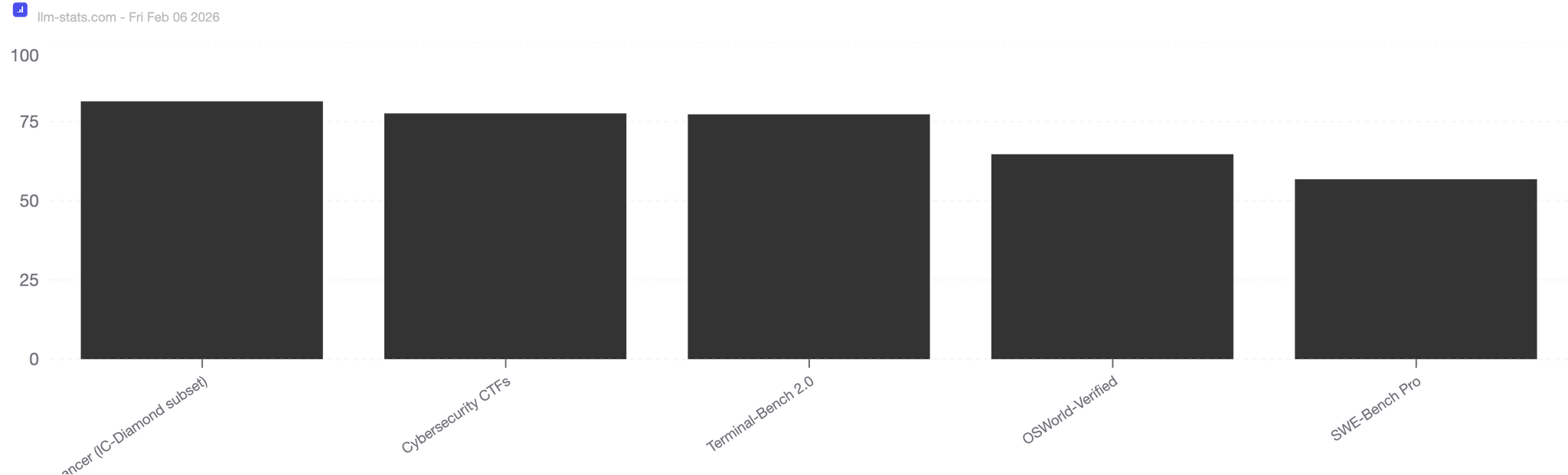
GPT-5.3 Codex benchmark results across key evaluation datasets, including SWE-Bench Pro, Terminal-Bench 2.0, OSWorld-Verified, Cybersecurity CTFs, and more. Source: llm-stats.com
Performance gains are even more pronounced in deployment scenarios. Terminal-Bench 2.0 measures command-line skills. Here, GPT-5.3-Codex achieved 77.3% accuracy, a massive leap from the 64.0% of its predecessor. This proves the model can navigate shell environments and manage file operations effectively. On OSWorld-Verified, which tests visual desktop tasks, the model reached 64.7% accuracy. It is rapidly approaching the human baseline of approximately 72%.
OpenAI validated these metrics through practical application. They tasked the model with building complex web games autonomously. It successfully created a racing game with distinct maps and a diving exploration game with oxygen mechanics. The model iterated on implementation, fixed bugs, and improved game feel without human hand-holding. These demonstrations confirm that high benchmark scores translate directly to usable product development capabilities.
Pricing, Access, and Competitive Landscape
Understanding gpt 5.3 codex pricing is essential for teams planning adoption. The model is available across ChatGPT Plus, Pro, Business, and Enterprise subscriptions. OpenAI has also announced limited-time access for Free and Go users to democratize access to these frontier capabilities. While the specific gpt 5.3 codex price for API usage is still being finalized, the company is doubling rate limits for paid plans to encourage intensive testing.
The gpt 5.3 codex api is currently under development. OpenAI is prioritizing safety evaluations before a full public rollout. However, the model's integration into the Codex app provides immediate value. Developers can choose between "terse" or "conversational" personalities, tailoring the AI's interaction style to their workflow.
Competition is fierce. Anthropic's Claude Sonnet 5 offers a larger context window, making it strong for system-level engineering. DeepSeek V3.2 provides a cost-effective alternative for iterative tasks. However, GPT-5.3-Codex holds a distinct advantage in output capacity and reasoning depth. It is the preferred choice for complex, multi-step project generation where maintaining context over long outputs is critical.
Quick Takeaways
- Release Date: The gpt 5.3 codex release date was early February 2026.
- Context & Output: Features a 400,000 token context window and a massive 128,000 token output limit.
- Benchmarks: Achieved 56.8% on SWE-Bench Pro and 77.3% on Terminal-Bench 2.0.
- Self-Creation: This is the first model instrumental in debugging and optimizing its own training process.
- Platform: Available via the new Codex app for macOS, serving as a command center for agentic workflows.
- Agentic Capabilities: Moves beyond coding to handle spreadsheets, design implementation, and infrastructure management.
- Pricing: Accessible via ChatGPT paid plans; API access is coming soon.
Conclusion
GPT-5.3-Codex is not just an upgrade; it is a redefinition of the developer experience. By bridging the gap between raw coding power and agentic reasoning, OpenAI has created a tool that acts as a true partner in the creative process. The ability to handle massive outputs, reason through complex architectures, and integrate directly into desktop workflows positions it as a vital asset for modern engineering teams.
The benchmarks speak for themselves, but the real value lies in the gpt 5.3 codex latency improvements and workflow integration. As organizations move from piloting AI to deploying it in production, the reliability and depth of this model will likely become the industry standard. We encourage developers to explore the technical report and test the model within the Codex app to experience this shift firsthand.
Questions
Frequently Asked Questions
OpenAI announced the release of GPT-5.3-Codex in early February 2026. It was launched alongside the new Codex app for macOS, with immediate availability for subscribers of ChatGPT Plus, Pro, and Enterprise plans.
The model is included in existing ChatGPT paid subscriptions (Plus, Team, Enterprise). While a specific pay-per-token price for the API has not yet been fully detailed, OpenAI has doubled rate limits for current subscribers. A promotional period also grants limited access to Free tier users.
The API is currently under development. OpenAI is pacing the rollout to ensure comprehensive safety evaluations and monitoring. They plan to enable safe API access soon, allowing developers to integrate these agentic capabilities into their own applications.
The model features a 400,000 token context window utilizing a “Perfect Recall” mechanism to prevent data loss. Distinctively, it pairs this with a 128,000 token output limit, allowing it to generate massive, multi-file software projects in a single interaction without needing to piece together short snippets.
OpenAI classifies the model as “High capability” for cybersecurity. To manage risks, they utilize a comprehensive safety stack including automated monitoring and “safe completions” training. They also run a Trusted Access program to help defenders utilize the model for vulnerability detection while mitigating potential misuse.
Continue Reading