
GLM-5: Zhipu AI's Agentic Engineering Breakthrough
A comprehensive analysis of Zhipu AI's GLM-5 — a 744B parameter MoE model with 44B active parameters, 200K context window, 77.8% on SWE-bench Verified, trained on Huawei Ascend chips, and released under the MIT license.


GLM-5 represents a watershed moment in the global artificial intelligence landscape. Released by Zhipu AI on February 11, 2026, this model bridges the gap between proprietary frontier systems and open-source capabilities. It operates as a massive 744-billion-parameter system with 44 billion active parameters per inference. This marks a distinct departure from traditional coding assistance. Zhipu positions GLM-5 not just as a chatbot, but as a comprehensive engine for agentic engineering and long-horizon task execution.
The development of GLM-5 carries significant geopolitical weight. It was trained entirely on domestically produced Chinese hardware using Huawei Ascend chips. This eliminates dependency on NVIDIA systems and signals a milestone in China's drive toward self-reliant AI infrastructure. The model enters the market with a clear strategic focus. It moves beyond "vibe coding" to facilitate complex system architecture and autonomous problem-solving. This article analyzes the architectural innovations, benchmark performance, and deployment realities of this new frontier model.
Architectural Foundation and Technical Design
GLM-5 introduces a substantial evolution in model architecture compared to its predecessors. Zhipu AI moved away from the iterative improvements seen in the GLM-4.5 and 4.7 series. The previous generation maintained a consistent design with 355 billion total parameters. GLM-5 scales this dramatically to 744 billion total parameters. Despite this massive size, it maintains computational efficiency through a sparse Mixture-of-Experts (MoE) framework. The model utilizes 44 billion active parameters per inference operation. This configuration consists of 256 total experts with 8 activated per token. The resulting sparsity rate of approximately 5.9 percent enables the system to handle nuanced reasoning without the latency penalties typically associated with dense models of this magnitude.
This architectural shift directly supports the model's primary use case of agentic engineering. Zhipu explicitly reframed the model's purpose from simple code completion to autonomous task decomposition. The architecture supports "agentic intelligence." This is the capacity to break down high-level objectives into subtasks and execute them with minimal human intervention. The design prioritizes state maintenance across long execution horizons. This is critical for scenarios involving autonomous system management and multi-stage workflow orchestration. Zhipu AI's technical report highlights this as a move toward genuine system-level reasoning rather than surface-level text generation.
The training foundation for GLM-5 is equally robust. The model ingested 28.5 trillion tokens during pre-training. This represents a 23.9 percent increase over GLM-4.7's data foundation. The increased data volume pairs with a novel training infrastructure known as "slime." This asynchronous reinforcement learning framework decouples data generation from model training. It allows independent generation of training trajectories. Zhipu also integrated Active Partial Rollouts (APRIL) to address long-tail generation bottlenecks. These innovations allowed the team to scale reinforcement learning effectively. They achieved stable convergence on a model size that typically presents massive engineering challenges.
Context Handling and Performance Benchmarks
A defining feature of GLM-5 is its integration of DeepSeek's Sparse Attention (DSA) mechanism. This technical partnership enables the model to process extended sequences efficiently. The mechanism uses a two-stage process involving a lightning indexer and a token selector. It reduces the computational complexity of attention from quadratic to linear. This allows GLM-5 to maintain a 200,000-token GLM-5 context window. This capacity is equivalent to approximately 300 pages of text. It does so while keeping inference costs viable for enterprise applications. Users can process large codebases or extensive technical documentation without requiring unrealistic hardware investments.
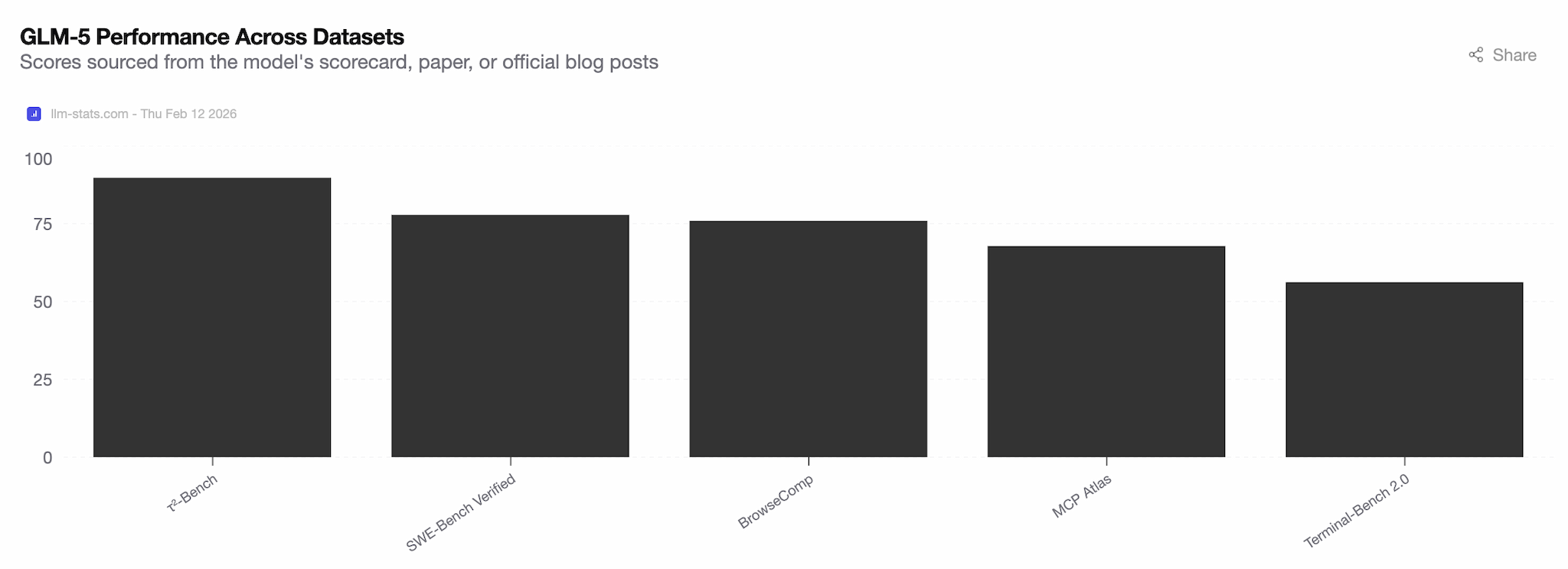
GLM-5 benchmark results across key evaluation datasets, including τ-Bench, SWE-Bench Verified, BrowseComp, MCP Atlas, and Terminal-Bench 2.0. Source: llm-stats.com
GLM-5 backs up its architectural claims with impressive scores on industry evaluations. On the SWE-bench Verified coding benchmark, GLM-5 benchmarks reached 77.8 percent accuracy. This outperforms Google's Gemini 3 Pro and approaches the 80.9 percent score of Claude Opus 4.6. The model also dominates in terminal-based task execution. It scored 56.2 percent on Terminal-Bench 2.0. Gains versus GLM-4.7 are driven by reduced hallucination rates and improved agentic performance, including a stronger tendency to abstain when confidence is low rather than fabricate.
Pricing, Deployment, and Market Positioning

GLM-5 pricing, performance, and capabilities overview. Source: llm-stats.com
The GLM-5 pricing strategy positions it as a disruptive force in the AI market. API access is priced at approximately $1.00 per million input tokens and $3.20 per million output tokens. This is significantly lower than competitors like Claude Opus 4.5, which costs $15.00 for inputs and $75.00 for outputs. The price differential makes GLM-5 roughly 15 times cheaper for inputs and 23 times cheaper for outputs. This aggressive pricing structure removes cost barriers for developers and enterprises looking to deploy frontier-class intelligence at scale.
Deploying GLM-5 locally presents challenges due to its sheer scale. The full model in native BF16 precision requires about 1.65 terabytes of storage. Inference demands approximately 1,490 gigabytes of memory. This exceeds the capacity of single GPUs and necessitates multi-GPU setups. However, quantization makes the model more accessible. Unsloth's quantization work shows the model can be compressed to 241 gigabytes in 2-bit format. This allows it to run on high-end consumer hardware like a Mac Studio with unified memory. These options enable meaningful engagement with the model without requiring an industrial-grade data center.
Zhipu AI released GLM-5 under the MIT license. This permissive licensing allows for unrestricted commercial use and adaptation. It contrasts sharply with the restrictive licenses of many proprietary models. The market responded enthusiastically to this release. Zhipu AI's shares surged on the Hong Kong Stock Exchange following the announcement. The company subsequently raised prices on its coding plan, reflecting high demand. This move signals a transition from aggressive user acquisition to sustainable commercialization. The combination of open weights, low API costs, and strong performance creates a compelling ecosystem for developers.
Quick Takeaways
- Massive Scale: GLM-5 features 744 billion parameters with 44 billion active parameters per inference using a sparse MoE architecture.
- Domestic Infrastructure: The model was trained entirely on Huawei Ascend chips, demonstrating China's AI hardware independence.
- Agentic Focus: Designed for complex engineering tasks and autonomous tool use rather than just conversational chat.
- High Performance: Achieves 77.8% on SWE-bench Verified and 56.2% on Terminal-Bench 2.0.
- Context Capacity: Supports a 200,000-token context window using DeepSeek's Sparse Attention mechanism.
- Cost Efficiency: GLM-5 price is substantially lower than Western competitors like Claude Opus 4.5.
- Open Availability: Released under the permissive MIT license, allowing for broad commercial application and modification.
Conclusion
GLM-5 stands as a definitive proof point that open-source models can compete directly with proprietary frontier systems. By achieving near-parity on critical benchmarks like SWE-bench Verified, Zhipu AI has challenged the dominance of closed-source providers. The model's ability to execute complex agentic workflows, combined with its massive 200k context window, makes it a powerful tool for serious engineering applications. Its development on Huawei hardware further underscores a shift toward a multipolar AI world where innovation is no longer the exclusive domain of Silicon Valley hardware supply chains.
The release offers immediate value to developers through its MIT license and aggressive API pricing. Organizations that were previously priced out of using frontier models for high-volume tasks now have a viable alternative. While the hardware requirements for local deployment are steep, the existence of quantization options and affordable API endpoints ensures broad accessibility. Developers and enterprise leaders should evaluate GLM-5 not just as another LLM, but as a specialized engine for building the next generation of autonomous software agents.
Questions
Frequently Asked Questions
- GLM-5 was released on February 11, 2026. You can access it through the Z.ai platform's API, the GLM-5 API endpoints, or by downloading the weights from Hugging Face for local deployment.
The model features a 200,000-token context window utilizing DeepSeek's Sparse Attention. This allows it to process roughly 300 pages of text efficiently, making it comparable to other long-context frontier models but with lower inference costs.
- Running the full model in BF16 precision requires approximately 1.65TB of storage and nearly 1.5TB of VRAM. However, using 2-bit quantization reduces memory needs to roughly 241GB, making it runnable on high-spec workstations like a Mac Studio.
- Yes, Zhipu AI has released technical details regarding the architecture, including the "slime" RL infrastructure and data composition. You can find these details in their official blog posts and technical documentation releases.
- GLM-5 is significantly cheaper. At approximately $1.00 per million input tokens, it is roughly 15 times less expensive than Claude Opus 4.5. This pricing makes it highly attractive for high-volume enterprise applications.
Continue Reading