
GLM-4.7: Pricing, Benchmarks, and Full Model Analysis
A comprehensive look at Zhipu AI's GLM-4.7 — the flagship foundation model with 200K context window, 128K output capacity, MoE architecture, 'Vibe Coding' capabilities, and what it means for developers and enterprises.

The landscape of artificial intelligence shifts rapidly. Just as developers settle into a workflow with one model, a new contender emerges to challenge the status quo. On December 22, 2025, Zhipu AI released GLM 4.7, their latest flagship foundation model. This release is not merely an incremental update. It represents a fundamental shift in how large language models handle complex reasoning, agentic coding, and long-context generation.
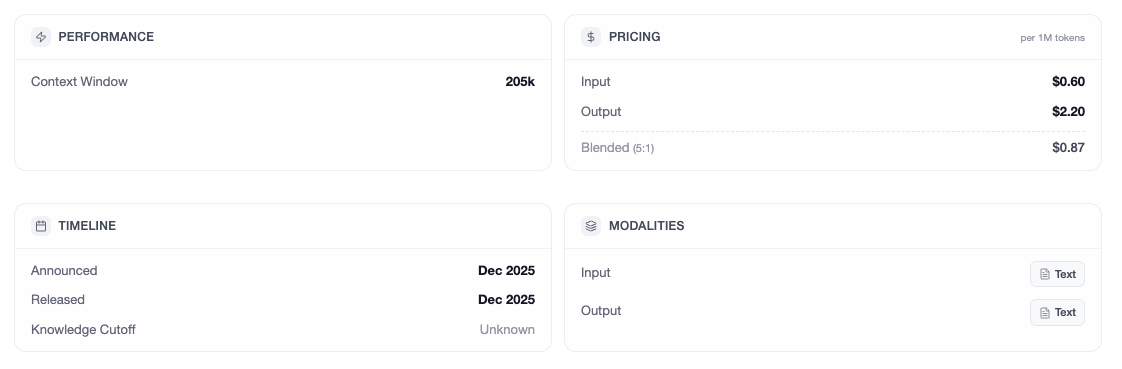
If you are an enterprise developer or an AI enthusiast, you need to understand the architecture behind this release. The model boasts a massive 200,000-token context window and a groundbreaking 128,000-token output capacity. These specifications allow it to generate entire software frameworks in a single pass. In this report, we will dissect the GLM 4.7 technical specifications, analyze its performance against major competitors like Claude 3.5 Sonnet, and breakdown the pricing economics that make it a viable option for production environments. We will explore why this model is currently dominating open-source benchmarks and how its "Vibe Coding" capabilities are changing frontend development.
GLM-4.7 Key Specifications
View GLM-4.7 details on LLM Stats ->
Technical Architecture and Core Specifications
GLM 4.7 utilizes a sophisticated Mixture-of-Experts (MoE) architecture. This design choice prioritizes computational efficiency without sacrificing depth. MoE systems mimic biological neural processing. They activate only specific regions of the model based on the task at hand. This results in faster token generation and lower energy costs compared to dense models. Zhipu AI has optimized GLM 4.7 to deliver high performance per unit of compute, a critical factor for scaling enterprise AI solutions.
The standout feature of this model is its handling of context. GLM 4.7 supports a maximum input context length of 200,000 tokens. This allows users to feed massive codebases, entire novels, or extensive technical documentation into a single prompt. However, the input is only half the story. The GLM 4.7 context window is paired with a maximum output capacity of 128,000 tokens. Most frontier models bottleneck at output, often cutting off after a few thousand words. This output capacity enables the model to write comprehensive reports or generate fully functional, multi-file software modules in one go.
This architecture is strictly text-based. It accepts text input and produces text output. While Zhipu AI offers multimodal variants like GLM-4V for vision tasks, GLM 4.7 focuses purely on language understanding and code generation. This specialization allows for deeper optimization in logic and reasoning. Developers accessing the GLM 4.7 API will find it supports standard chat completion requests, making it a drop-in replacement for existing OpenAI-compatible workflows.
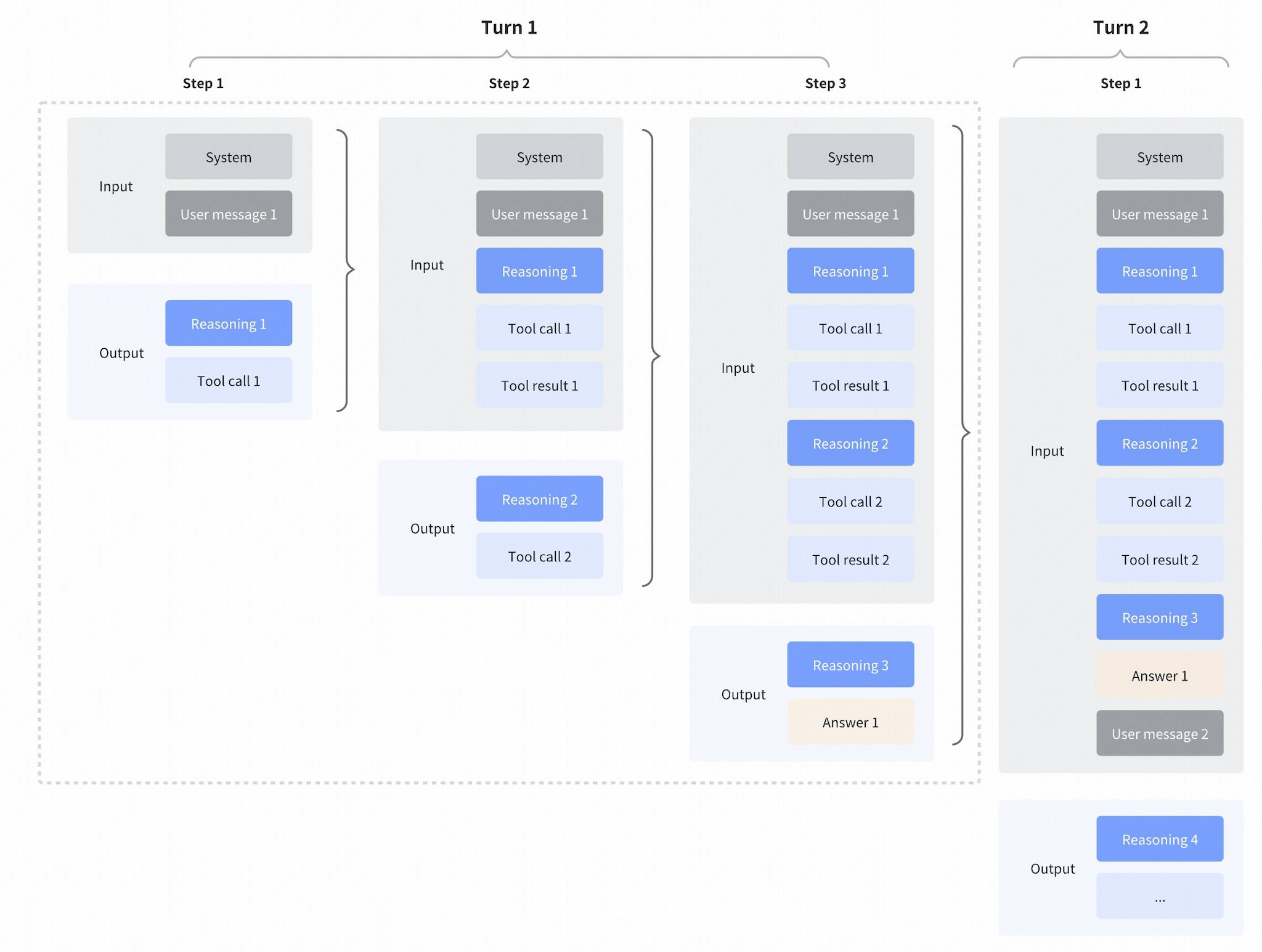
*GLM-4.7's Interleaved Thinking architecture: the model reasons before every response and tool call across multi-step turns. Preserved Thinking retains reasoning blocks across conversations, reducing information loss. This enables stable, controllable execution of complex agentic tasks. [Source: Z.ai](https://z.ai/blog/glm-4.7)*
Coding Capabilities and "Vibe Coding"
The most discussed feature of the GLM 4.7 release is its programming prowess. Zhipu AI has tuned this model for "agentic coding." This means the model focuses on task completion rather than simple snippet generation. It can decompose high-level requirements into executable steps. It handles the entire lifecycle of a coding task, from requirement comprehension to multi-stack integration. This reduces the manual assembly usually required by human developers.
A unique insight regarding GLM 4.7 is its capability known as "Vibe Coding." This refers to the model's enhanced aesthetic intelligence. It generates cleaner, more modern user interfaces by default. When asked to create a webpage or a slide deck, it understands visual hierarchy, color harmony, and layout structure better than its predecessors. It significantly reduces the time developers spend "fixing" the ugly default CSS often produced by other LLMs. This makes it an ideal backend for low-code platforms and rapid prototyping tools.
The model also integrates seamlessly with modern agent frameworks. It works out of the box with tools like Claude Code, Cline, and Roo Code. In real-time application development, such as building interactive dashboards or camera-based apps, GLM 4.7 demonstrates superior system-level comprehension. It can logically control application flow and manage state more effectively than [
Benchmark Performance and Reasoning
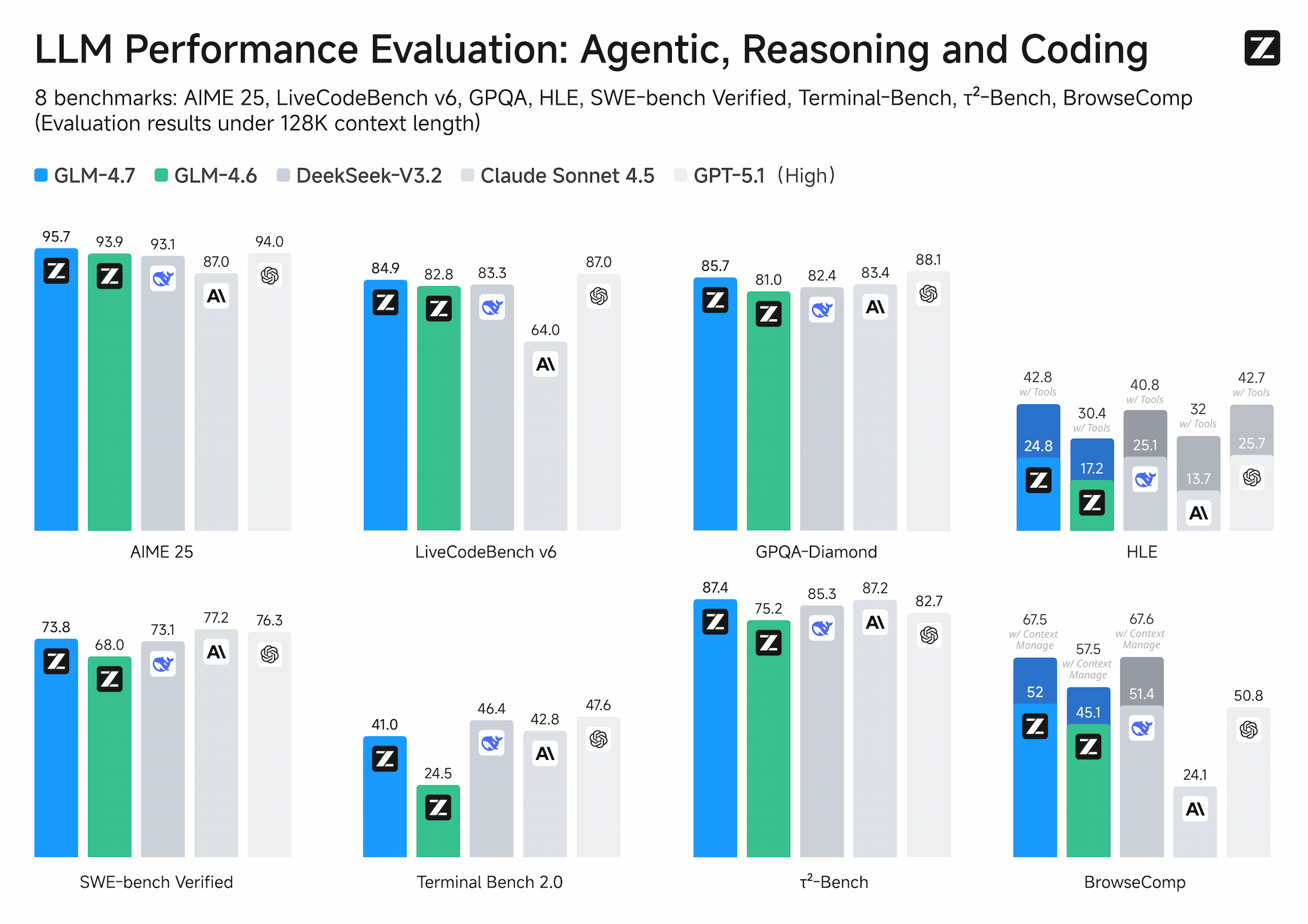
In the world of LLMs, numbers tell the story. GLM 4.7 benchmarks show a clear leap in performance, particularly in reasoning and mathematics. The model achieves a score of 42.8% on the Humanity's Last Exam (HLE) benchmark. This is a rigorous test designed to evaluate reasoning on problems found in advanced academic settings. This score represents a massive +12.4% improvement over GLM-4.6. It signals that the model is not just memorizing data but actually reasoning through complex logic.
View detailed benchmark results ->
For software engineering, the results are equally impressive. On SWE-bench, the standard for evaluating real-world coding capabilities, GLM 4.7 scores 73.8%. This is a 5.8% gain over its predecessor. Even more notable is the performance on SWE-bench Multilingual, where it achieves 66.7%, a jump of nearly 13%. This proves the model is highly capable of handling non-English codebases and international development environments.
The model also sets a new standard for tool use. It achieves open-source state-of-the-art (SOTA) results on $\tau^2$-Bench. This benchmark evaluates how well an agent can select and sequence tools to solve a problem. High performance here means GLM 4.7 can reliably plan multi-step workflows, such as searching the web, analyzing data, and writing a report, without losing track of the original goal. It also excels in web browsing tasks via BrowserComp, making it a powerful engine for deep research applications.
Pricing, Economics, and Availability

See pricing and available providers ->
Understanding the GLM 4.7 price structure is essential for decision-makers. Zhipu AI has positioned this model competitively. The API pricing is set at roughly $0.60 per 1 million input tokens and $2.20 per 1 million output tokens. This is significantly more affordable than many proprietary frontier models. Furthermore, Zhipu AI offers a Context Caching mechanism. If your application reuses prompts or system messages, cached input tokens are billed at a significantly reduced rate (approx. $0.11 per 1M). This can reduce total costs by 20-40% for heavy-duty applications.
For individual developers, there are "GLM Coding Plans." These provide tiered access to the models via integrations with tools like Claude Code or VS Code extensions. A "Lite" plan starts around $3/month for limited prompts, while "Pro" plans offer higher limits. This makes the model accessible to freelancers and students, not just large enterprises.
Deployment flexibility is another strong point. You can access the model via the official Z.AI platform using standard API keys. Alternatively, it is available through third-party aggregators like OpenRouter and Novita AI. These marketplaces often provide unified billing and can act as a fallback if one provider goes down. While the weights for GLM 4.7 are not yet fully open-source like GLM-4.9B, the company has a strong track record of releasing weights eventually, as seen with GLM-4.5.
Quick Takeaways
- Massive Output: 128k output token limit allows for generating complete software modules in one pass.
- Reasoning Powerhouse: Scores 42.8% on the HLE benchmark, a 12.4% jump over the previous generation.
- Vibe Coding: Specializes in generating aesthetically pleasing UI code, reducing frontend design time.
- Cost Effective: Competitive pricing at $0.60/1M input tokens, with significant discounts for cached context.
- Agent Ready: Native integration with tools like Cline and Roo Code; excels at multi-step tool use.
- Coding SOTA: Achieves 73.8% on SWE-bench, proving it handles real-world GitHub issues effectively.
- Deployment: Available via official API and major aggregators like OpenRouter for immediate integration.
Conclusion
GLM 4.7 is a formidable entry in the generative AI space. It successfully bridges the gap between raw computational power and practical application. By focusing on high-utility features like "Vibe Coding," massive output windows, and deep reasoning, Zhipu AI has created a tool that directly addresses the pain points of modern developers. It does not just write code. It architects solutions.
For enterprises, the combination of the GLM 4.7 pricing model and its ability to handle massive contexts makes it a highly attractive alternative to more expensive western models. The efficiency gains from the MoE architecture ensure that scaling your application won't break the bank. Whether you are building autonomous agents, complex data analysis pipelines, or simply need a better coding assistant, this model demands your attention. We recommend testing it via the API or through a platform like OpenRouter to see how it handles your specific use cases.
Questions
Frequently Asked Questions
- GLM 4.7offers significant improvements in reasoning and coding. It features a +12.4% increase in HLE reasoning scores and a +5.8% increase in SWE-bench coding scores. It also introduces “Vibe Coding” for better UI generation and improved multi-step tool use capabilities that were less refined in version 4.6.
- While a formal academic GLM 4.7 paper has not been widely publicized in the same manner as initial GPT releases, Zhipu AI provides extensive technical documentation and release notes. These documents detail the MoE architecture, benchmark results, and capability upgrades directly on their developer platform.
- Yes. The model supports standard token streaming and a unique feature called
tool_stream. This allows developers to receive tool call parameters in real-time as they are being generated. It reduces latency in agentic applications by allowing the system to prepare for actions before the model finishes speaking. - Currently, GLM 4.7 is primarily available via API. However, Zhipu AI has a history of open-sourcing model weights, as seen with GLM-4.5. Users looking for local deployment should monitor Hugging Face and ModelScope for future weight releases or use the smaller open-source variants of the GLM-4 family.
The model supports a 200k context window. To manage costs, GLM 4.7 utilizes context caching. If you send the same large preamble or documentation multiple times, the system caches it. You pay a significantly reduced rate (approx. $0.11/1M tokens) for the cached portion, making long-context tasks much more economical.
Continue Reading